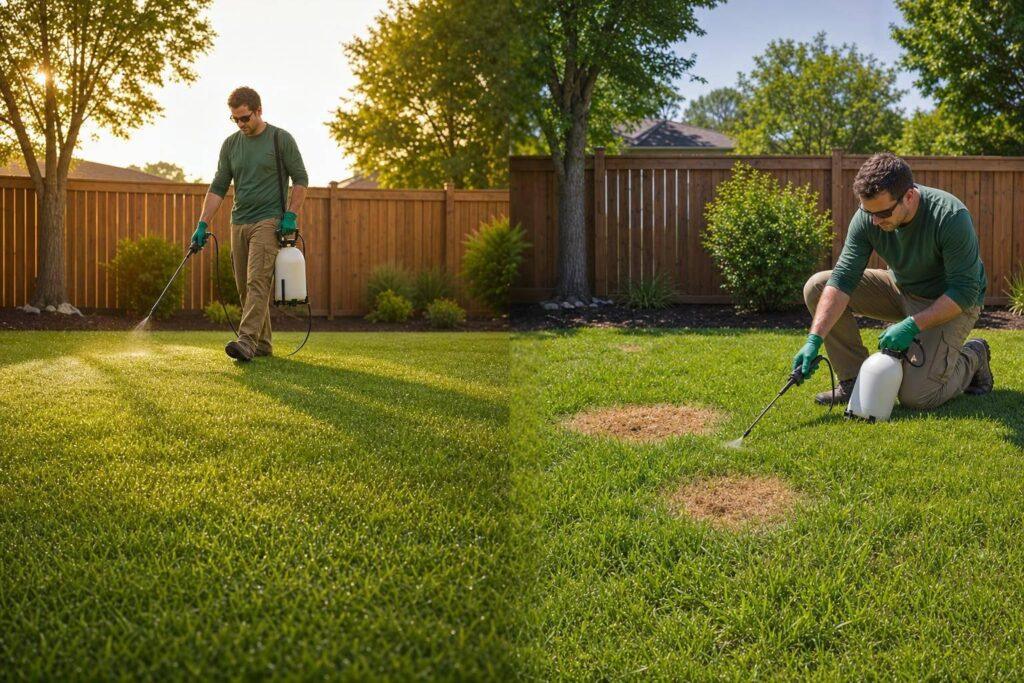
If you wait until you see lawn disease, you’ve already lost part of the battle. In most cases, preventative fungicides work best when a lawn has a history of disease, high appearance demands, shade, poor drainage, or hot, humid weather on the way. Curative fungicides are more useful when disease shows up early and you need to slow it before more turf is damaged.
Here’s the short version:
- Preventative treatments go down before symptoms.
- Curative treatments go down after symptoms start.
- Neither one repairs dead grass.
- Preventative rates are usually lower than curative rates.
- FRAC rotation matters if you want products to keep working.
- The “150 Rule” can help with timing: when the day high plus night low hits 150°F, disease risk is climbing.
- Lawn care still matters: 3–4 inch mowing, morning watering, less summer nitrogen, and annual aeration can cut disease pressure.
If I were deciding between the two, I’d keep it simple: use prevention on lawns that can’t afford visible damage, and use curative treatments only when I catch the problem early and the site can tolerate some thinning.
Quick Comparison
| Criteria | Preventative | Curative |
|---|---|---|
| When I use it | Before infection | After infection starts |
| Main goal | Protect healthy turf | Slow spread |
| Turf appearance | Helps keep density and color | Often leaves thin or scarred spots |
| Product rate | Standard label rate | Higher labeled rate |
| Best fit | Repeat disease, high-risk sites, residential lawn care in Oakville | Surprise outbreaks, lower-priority turf, early symptoms |
| Limits | Won’t fix dead grass | Won’t fix dead grass |
| Timing risk | Too late = less protection | Too late = more turf loss |
| Resistance planning | Rotate FRAC codes | Rotate FRAC codes |
That’s the whole decision in plain English: prevent when risk is easy to see, treat early when it’s not.
sbb-itb-5aa6250
How Turfgrass Fungicides Work and Why Timing Is Critical
Fungicides protect healthy turf and slow disease that’s already active. But they can’t bring dead blades or crowns back to life. That’s why timing matters so much. The type of fungicide you use, how well you cover the turf, and when you spray all shape the outcome. In plain terms, a treatment either helps prevent infection or just limits damage that has already started.
Contact fungicides stay on the leaf surface and kill spores when they touch them. Since they don’t move into the plant, they need solid coverage across the whole canopy. Miss spots, and you leave room for disease to get in.
Systemic and translaminar fungicides work differently. They move into plant tissue, which gives them an edge when a pathogen has already started pushing into the leaf. That’s why systemic products often make more sense when early symptoms show up. Contact products, on the other hand, tend to work best as a protective barrier before disease pressure starts climbing.
Disease pressure goes up when turf stays wet overnight and the weather turns warm and humid. In those stretches, getting a protectant out before those conditions arrive works better than waiting until you can see symptoms.
Key Terms Used in Fungicide Programs
A few label terms come up again and again. Knowing what they mean makes product labels and treatment plans a lot easier to read.
- Protectant – Sits on the leaf surface and blocks infection.
- Translaminar – Moves into the leaf and protects treated tissue.
- Acropetal penetrant – Moves upward through the plant to protect new growth.
- Curative – Slows an infection already underway.
- FRAC code – Identifies the mode of action for rotation planning.
These terms matter because a product only does its job when it fits the disease stage and the turf’s condition. Curative rates are usually higher than preventative rates, so prevention tends to be the more efficient path.
Resistance Management Basics
Fungal pathogens can change over time. If you rely on the same chemistry again and again, some strains may survive and pass that tolerance along. Resistance is already a problem in several major fungicide classes.
The main rule is simple: rotate FRAC codes between applications. Don’t make two back-to-back applications from the same chemical group, even if the label or brand name looks different.
"Changing fungicides by brand or trade name will not prevent resistance if the active ingredient or chemical group is the same." – UMass Extension
It also helps to work multi-site fungicides into the rotation. These often carry "M" FRAC codes. Since they hit fungal cells at several points at once, they’re much harder for pathogens to sidestep. This is one reason prevention plans are easier to manage than last-second curative treatments. Timing and mode of action aren’t small details here – they’re the line between a preventative program and a curative one.
Preventative vs. Curative Fungicide Applications: Direct Comparison
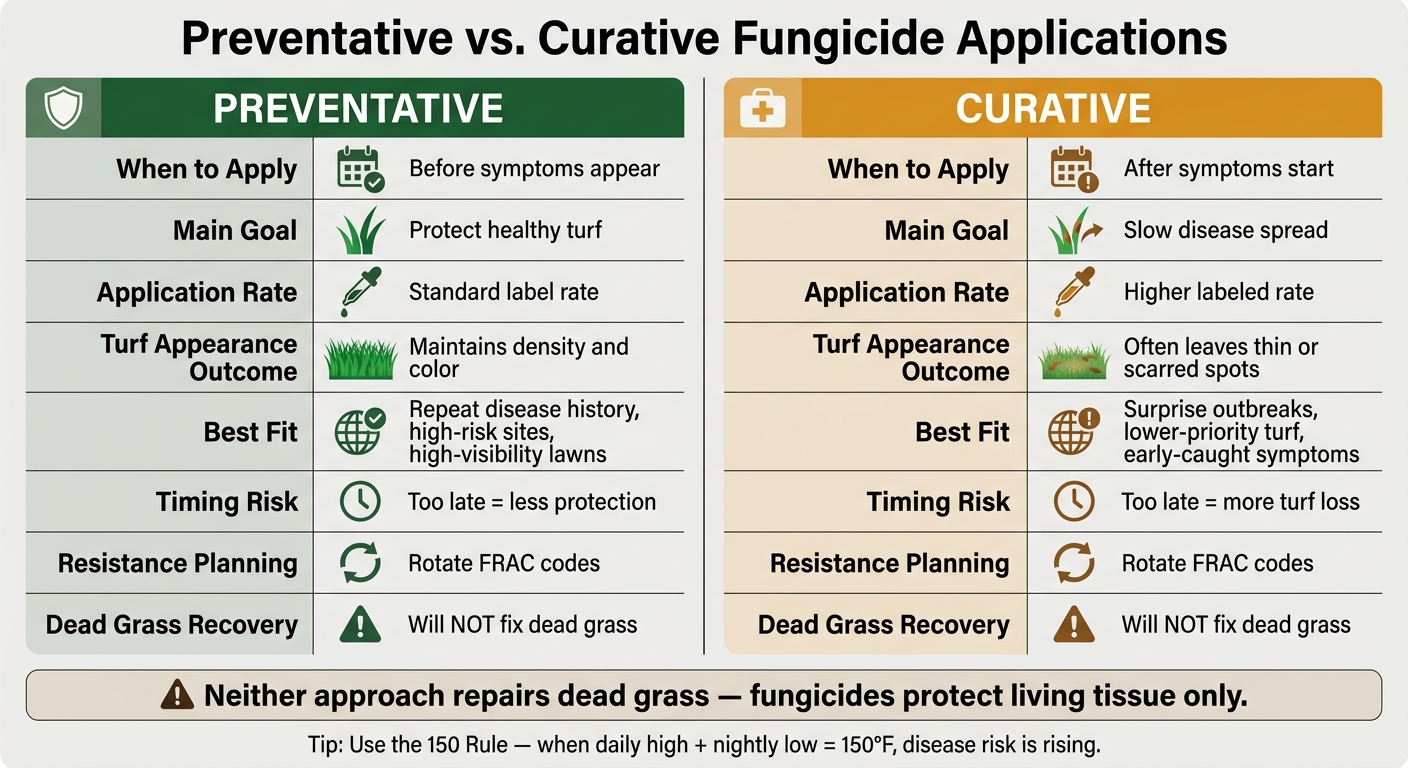
Preventative vs. Curative Fungicide: Side-by-Side Comparison
The main difference comes down to timing. Preventative fungicides protect turf before symptoms show up. Curative fungicides are used after disease is active to slow the outbreak. That one choice affects cost, recovery time, and how much turf damage you avoid in the first place.
| Feature | Preventative Application | Curative Application |
|---|---|---|
| Turf Quality | Maintains density and appearance | Stops spread; leaves scars or thinning |
| Application Rate | Standard label rate | Higher labeled rate |
| Practical Use | High-value or high-risk sites | Unexpected outbreaks caught early |
From there, the right move depends on turf value, disease history, and site conditions.
When Preventative Applications Make More Sense
Preventative programs make the most sense for high-value turf, commercial properties with strict appearance standards, and any site with a clear history of the same disease coming back year after year. If a lawn keeps running into the same issue every season, waiting for symptoms to show up again isn’t much of a plan. It’s just crossing your fingers.
They also make sense in problem spots like shaded areas, low areas with poor drainage, and parts of the property where weak airflow keeps turf wet for longer. In those zones, a well-timed preventative program, applied before peak-risk conditions hit, can stop the thinning and scarring that often take weeks to fill back in.
When Curative Applications Are More Practical
Curative treatments are often the better fit for low-maintenance turf or surprise outbreaks where there was no clear disease history. If symptoms are caught early, before the disease has moved across a large area, a curative application can slow it down and help protect nearby healthy turf.
That said, timing still matters. Once disease is widespread, curative products can only limit further spread. Dead tissue will not recover.
Why Many Properties Benefit from a Combined Approach
Most professionals don’t treat this as a hard either/or decision. A more practical plan is to run a base preventative program during peak disease windows, then keep curative treatments ready for weather-driven flare-ups.
That approach works even better when it’s paired with professional lawn maintenance, such as:
- Shifting irrigation to early morning
- Maintaining mowing heights at 3–4 inches
- Avoiding excess nitrogen during hot, humid stretches
That mix helps lower disease pressure while keeping the program responsive without overapplying product.
Choosing the Right Fungicide Strategy for Your Property
Factors That Should Drive the Decision
Once you know a disease may come back, the next step is looking at site risk. That’s what tells you whether prevention or rescue makes more sense.
A property’s disease history is often the clearest clue. If a lawn deals with repeat summer issues like Brown Patch or Dollar Spot, a preventative program usually makes more sense. Past trouble is a strong sign that future outbreaks are likely.
Beyond that, turf species matters a lot. Tall Fescue and Perennial Ryegrass are highly susceptible to Brown Patch. Kentucky Bluegrass, on the other hand, is especially prone to Necrotic Ring Spot. If you know what’s growing on the site, you already know a lot about the level of risk before any symptoms show up.
Site conditions matter too. Soil compaction and thatch buildup over 1/2 inch can increase disease pressure even when the surface looks fine. Shade, drainage issues, compaction, and excess thatch all push the decision toward prevention because they make outbreaks easier to predict.
A simple weather cue can help with timing: the "150 Rule". When the daily high temperature plus the nightly low adds up to 150°F, disease pressure is building and conditions are ripe for an outbreak. It’s best used as an early warning, not the only signal. Start checking 10-day forecasts in late April or early May so you’re not caught off guard.
The more risk factors a property has, the stronger the case for prevention.
Appearance standards matter too. Curative treatments can stop a disease from spreading, but they can’t bring dead turf back. Recovery may take weeks. If a property needs to look clean and uniform, prevention is often the better call. High-risk turf with little room for blemishes leans toward prevention. Lower-risk areas, or turf in spots people rarely notice, may justify curative use.
How Fungicides Fit into a Full Lawn Care Plan
Fungicides work best when they support turf practices that lower disease pressure.
"Fungicides fail when cultural conditions still favor disease."
That’s why fungicide timing should match the rest of your maintenance calendar, especially nitrogen management. Too much summer nitrogen can make Brown Patch and Pythium Blight worse, so fertilizer plans should reflect disease risk.
Aeration and mowing also have a direct effect. Thatch buildup and compacted soil make turf more vulnerable. Annual core aeration, proper mowing height, and morning irrigation help lower disease pressure.
Conclusion: Matching Your Fungicide Approach to Disease Risk and Turf Goals
Neither approach fixes dead grass. Fungicides protect living tissue only.
So the choice comes down to disease risk, site conditions, and timing. It also depends on how much visible damage the site can live with. High-value turf with strict appearance standards doesn’t leave much margin for error, which makes a preventative program the better fit.
On lower-risk sites, a curative response at the first sign of symptoms can make sense. But there’s a catch: recovery takes time, and dead turf won’t return on its own.
That call also needs to fit a resistance-aware spray program. Extending intervals during high-pressure weather can increase breakthrough risk. Shortening intervals adds cost, not extra protection, and it can increase resistance risk too. Rotate FRAC groups and follow label timing so treatments keep working through the full season.
Match the fungicide plan to disease risk, site conditions, budget, and appearance goals.
FAQs
How do I know if my lawn is high-risk?
Your lawn is at high risk when a few warning signs line up.
One of the biggest is the 150 Rule. If the day’s high temperature plus the previous night’s low keeps adding up to 150 or more, disease pressure is high.
Past lawn history matters too. If disease tends to come back in the same areas, that’s a red flag. The same goes for weather that leaves grass damp for long stretches, like:
- Extended high humidity
- Heavy rain
- Leaf wetness lasting 8 to 12 hours
That mix of heat, moisture, and repeat trouble spots can put your lawn in the danger zone.
What lawn diseases are most likely to need prevention?
Preventative fungicide applications work best for lawn diseases that show up year after year. Good examples include brown patch in tall fescue and large patch in warm-season grasses.
They also matter for soilborne diseases like take-all root rot. That disease can start doing damage below the surface before you see obvious signs in the lawn. By the time symptoms show up, the problem may already be well underway.
That’s why it helps to look beyond the calendar. Instead of treating on date alone, pay attention to environmental signals like soil temperature, moisture, and nighttime temperatures. Those conditions often tell you more about disease risk than the month on the calendar.
Can I combine fungicides with better lawn care practices?
Yes. Fungicides tend to work best when you pair them with better lawn care, because on their own they usually act as a short-term fix.
A few lawn habits can make a big difference:
- Adjust your mowing height
- Fine-tune irrigation so the lawn doesn’t stay too wet
- Make sure fertilization is on track
When you combine those steps, you help build a healthier, more resilient lawn. That can also cut back on long-term dependence on chemical treatments.