For lawns in Oakville and Mississauga, I’d plan fall feeding for October – only while grass is still growing and soil is unfrozen. One application may be enough; two should serve separate needs, not make up for missed dates.
Here’s the plan I’d follow:
- Check past feedings and soil-test results. Count starter fertilizer toward your fall total, and choose nutrients your lawn needs.
- Measure before spreading. A 20% nitrogen fertilizer supplies 1 lb of nitrogen with 5 lb of product per 1,000 sq. ft. – but your product’s label sets the rate.
- Match the product to the timing. Use slow-release nitrogen earlier in fall and quick-release nitrogen later, within label limits.
- Prepare and apply with care. Schedule aeration and overseeding while there’s time for grass to establish, clear thick leaves, calibrate your spreader, and follow watering directions.
- Watch the weather. <u>Skip frozen, snow-covered, or saturated soil</u>, and wait if heavy rain is expected.
My rule: follow the lawn, not just the calendar. Finish fall cleanup and irrigation winterization before freezing weather, then check spring growth before feeding again.
Plan Your Ontario Fall Fertilization Schedule
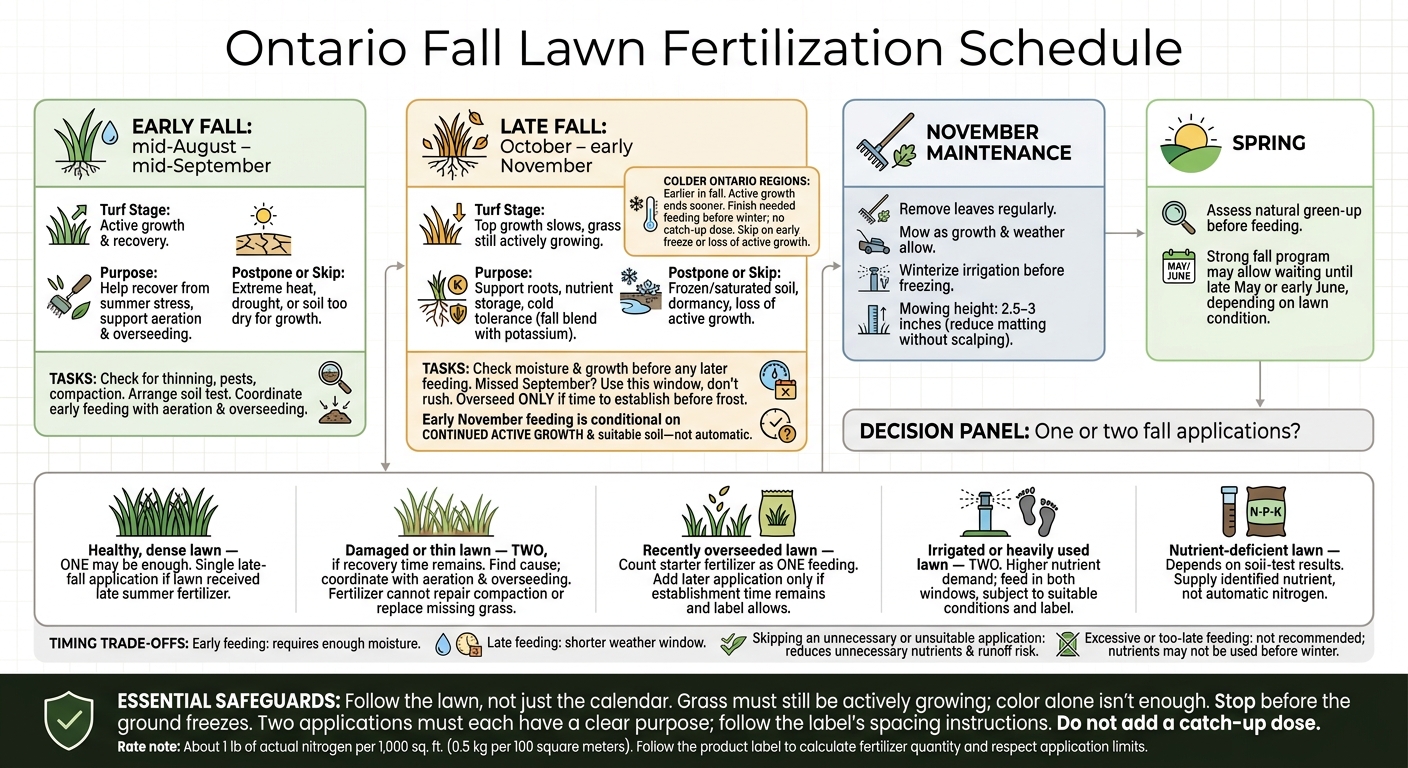
Ontario Fall Lawn Fertilization Schedule
When to Fertilize in Early and Late Fall
Plan each feeding around Ontario’s shortening fall season. Aim for about 1 lb of actual nitrogen per 1,000 sq. ft. (0.5 kg per 100 square meters). Follow the label to calculate how much product you need to supply that nitrogen.
| Feeding window | Turf stage | Purpose | When to postpone or skip |
|---|---|---|---|
| Early fall: mid-August through mid-September | Active growth and recovery | Help grass recover from summer stress and support aeration and overseeding | Extreme heat, drought, or soil too dry to support growth |
| Late fall: October to early November | Top growth slows, but grass is still actively growing | Support roots, nutrient storage, and cold tolerance with a fall blend containing potassium | Frozen or saturated soil, dormancy, or loss of active growth |
| Colder Ontario regions: earlier in fall | Active growth ends sooner | Finish needed feeding before winter without an extra catch-up dose | An early freeze or loss of active growth |
Check local grass growth and soil conditions before feeding. Color alone isn’t enough – the lawn must still be actively growing. Stop before the ground freezes.
Decide Between 1 or 2 Fall Applications
Let the lawn’s condition and feeding history guide your choice, not just the calendar. Apply twice only when the early- and late-fall feedings each have a clear purpose. Follow the label’s spacing instructions.
| Lawn condition | One or two applications? | What determines the choice |
|---|---|---|
| Healthy, dense lawn | One may be enough | A single late-fall application may suffice if the lawn is dense and received fertilizer in late summer |
| Damaged or thin lawn | Two, if recovery time remains | Find the cause of damage first, then coordinate feeding with aeration and overseeding. Fertilizer cannot repair compaction or replace missing grass. |
| Recently overseeded lawn | Count starter fertilizer as one feeding | Add a later application only if there’s still time for establishment and the label allows it |
| Irrigated or heavily used lawn | Two | Higher nutrient demand calls for feeding in both the early- and late-fall windows |
| Nutrient-deficient lawn | Depends on soil-test results | Supply the nutrient identified by the soil test rather than automatically adding more nitrogen |
The timing also comes with trade-offs:
| Choice | Useful when | Main trade-off |
|---|---|---|
| Early feeding | Grass needs recovery and still has time to establish | Requires enough moisture |
| Late feeding | Grass remains active as top growth slows | The weather window is shorter |
| Skip an application | Previous feeding is enough or conditions aren’t suitable | Avoids unnecessary nutrients and runoff risk |
| Excessive or too-late feeding | Not recommended | Adds nutrients the lawn may not use before winter |
Use the lawn’s needs and these timing limits to schedule each feeding.
Lawn Care Calendar: August Through Spring
August and September: Check for thinning, pests, and compaction. Arrange soil testing, and coordinate early feeding with aeration and overseeding.
October: Check moisture and growth again before any later feeding. If you missed September’s dose, use the late-fall window rather than rushing an application. Overseed only if the seed has enough time to establish before frost.
November: Remove leaves regularly, mow as growth and weather allow, and winterize irrigation before freezing conditions arrive. Keep mowing height at 2.5–3 inches to reduce matting without scalping.
Spring: Assess natural green-up before feeding. A strong fall program may let you wait until late May or early June for the next application, depending on the lawn’s condition.
With timing set, match the fertilizer grade and spreader rate to your lawn’s size.
sbb-itb-5aa6250
Choose Fertilizer and Calculate Application Rates
Once you’ve set the timing, choose a fertilizer that matches your lawn care needs and follow the label rate.
Choose Nutrients and Nitrogen Release Types
Read the nutrient analysis – not just the winterizer fertilizer label. The N-P-K numbers show the nutrient balance. Use your soil test to guide nutrient choices, especially nitrogen and potassium. Fall nitrogen helps turf recover and green up in spring; potassium improves cold tolerance.
For newly seeded turf, use a starter fertilizer made for establishment and follow its label. Choose slow-release nitrogen for early-fall recovery and quick-release nitrogen for late-fall feeding before dormancy.
| What to check | Slow- or controlled-release nitrogen | Quick-release nitrogen |
|---|---|---|
| Best use | Early-fall recovery and steady growth | Late-fall feeding before dormancy |
| Temperature effects | Some forms depend on microbes and release more slowly in cool soil | Becomes available quickly, but cold or dormant turf may not use it |
| Advantage | Gradual feeding with less risk of burn or leaching when applied properly | Supplies nitrogen before dormancy |
| Limits and label cautions | Check release duration and temperature guidance | Follow rate limits closely; don’t apply just before heavy rain or on frozen soil |
Measure Your Lawn and Calculate Fertilizer Weight
Measure each lawn section, multiply its length by its width, and add the totals. Subtract beds, patios, and pavement. 1,000 sq. ft. equals about 92.9 square meters.
To find the product weight, use required nitrogen ÷ nitrogen percentage expressed as a decimal. Keep the amount within the label’s application limits.
For a hypothetical example, a 20% nitrogen fertilizer supplies 1 lb of nitrogen with 1 ÷ 0.20 = 5 lb of product per 1,000 sq. ft., or approximately 2.44 kg per 100 square meters. At that rate, a 4,000-sq.-ft. lawn would need 20 lb.
Use the rate your lawn and label require.
Calibrate Your Fertilizer Spreader
Start with the label’s spreader setting. Test it over a measured area, then adjust before treating the lawn to avoid missed strips and overlaps.
With the product and rate set, move on to lawn prep and safe application.
Apply Fertilizer Safely and Plan Fall Lawn Care
Check Soil, Grass, and Weather Before Applying
After setting the fertilizer rate, check the lawn’s condition. Grass should be green and actively growing. The soil should be unfrozen and drain normally. Use a soil moisture meter to check whether the lawn needs water or is already saturated, then review the rainfall forecast. Skip snow-covered or saturated areas, and wait if heavy rain is expected.
Follow the label’s watering directions. Water in the morning so grass blades can dry before nightfall. Brush spilled granules from sidewalks and driveways back onto the lawn to keep them out of storm drains and waterways.
Schedule Aeration, Overseeding, and Cleanup
Finish any work that affects soil contact or seed establishment before applying fertilizer. Aerate before overseeding to loosen compacted soil and help seeds make contact with it. Schedule both tasks early enough for the new grass to establish before frost. If you overseed, use a starter fertilizer and keep the soil moist for the first few weeks.
Clear thick leaves before spreading fertilizer, and finish irrigation winterization before the first freeze.
Plan Fall Maintenance With Dependable Lawn Care
For properties in Oakville and Mississauga, coordinate fertilization with Dependable Lawn Care’s aeration, seasonal cleanup, and irrigation services to keep fall tasks on the same schedule.
Conclusion: Review Your Fall Fertilization Plan
Before the final application, check your schedule, fertilizer rate, and weather as part of your fall lawn care. Healthy lawns often need one late-fall feeding. Thin or overseeded lawns may need two, following the product label.
Choose fertilizer based on your soil test. Measure the lawn, calculate the application rate from the label, and calibrate the spreader before you apply.
Final checklist: soil test reviewed; lawn area measured; weather checked; fertilizer rate calculated; spreader calibrated.
Let product labels, turf conditions, and local weather guide your timing – not calendar dates. Delay application until the lawn is actively growing and the soil is workable. Properly timed fall feeding supports stronger roots now and faster green-up next spring.
FAQs
How can I tell if my grass is still growing?
More frequent mowing is a sign that your grass is actively growing. Its growth depends mainly on temperature, moisture, sunlight, and available nutrients. Cool-season grasses grow most actively in early spring and fall, while warm-season grasses thrive from late spring through early fall.
Yellowing, wilting, or slow growth can signal stress. These changes may also mean your grass is entering dormancy as temperatures shift.
What if frost arrives right after fertilizing?
A winter fertilizer blend with nitrogen and potassium helps grass handle cold and frost, survive dormancy, and recover in spring [1]. Apply it before frost arrives and the ground freezes [1][2]. A potassium-heavy winterizer applied in late October or early November helps grass resist cold and disease [3].
If you’re worried about frost damage or unsure which nutrients your lawn needs, Dependable Lawn Care offers professional lawn health assessments [1].
How soon can I fertilize after overseeding?
Apply a starter fertilizer soon after overseeding to support healthy growth [1]. Finish both tasks before the first frost for the best results [1].
Dependable Lawn Care provides residential and commercial lawn care in Oakville and Mississauga. Its services include lawn rehabilitation and tiered maintenance plans to help you handle these seasonal tasks.