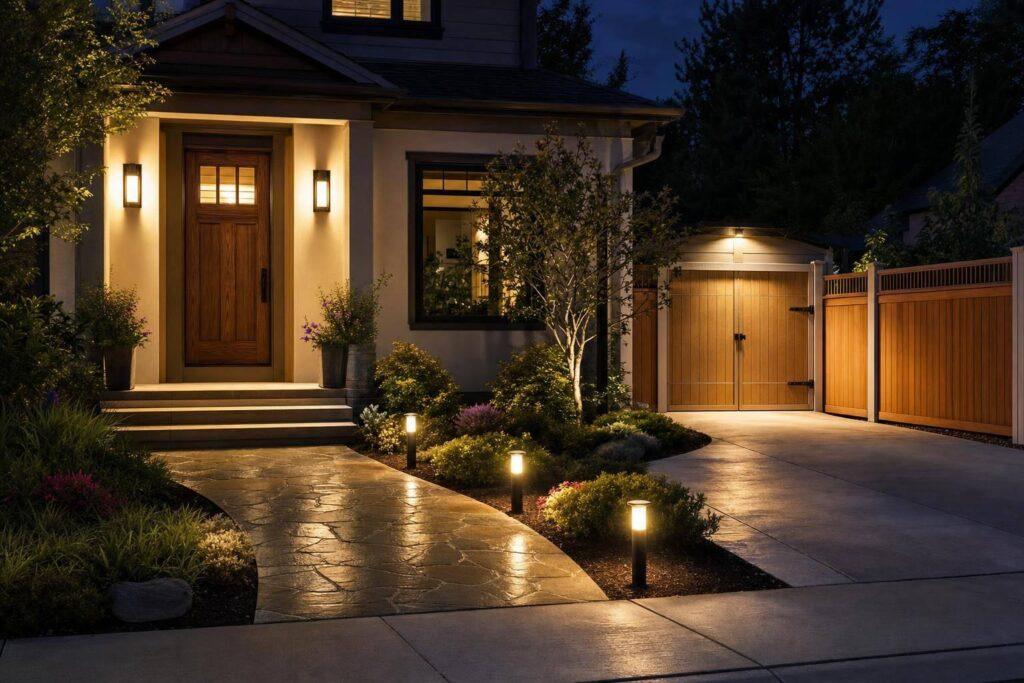
Better outdoor lighting cuts two big risks at once: falls and blind spots. I’d focus on four things first: light every entry point, fill dark gaps along paths and steps, cover side yards and driveways, and use motion sensors or dusk-to-dawn controls so lights run when needed.
In plain terms, this article comes down to this:
- Dark steps, paths, and uneven pavement lead to trips and falls
- Shadowed corners, gates, and garages make it harder to spot movement
- LED lights work best when coverage is even, not just bright in one spot
- Downward-aimed fixtures help light the ground and cut harsh glare
- Path lights should usually be spaced about 6 to 10 feet apart
- Main access points should stay lit, while lower-traffic areas can use sensors
I’d plan the layout in three simple zones:
- Access points – front door, back door, garage, gates
- Travel paths – walkways, steps, driveway edges
- Perimeter areas – side yards, corners, fence lines
A few facts help explain why this matters. The CDC reports that millions of older adults fall each year in the U.S., and poor visibility can add to that risk outdoors. On top of that, the U.S. Department of Energy has long noted that LED bulbs use far less energy than older incandescent bulbs and can last much longer, which helps keep safety lighting on without pushing power use too high.
What I like about this approach is that it’s simple: walk the property at night, find the dark gaps, and light each zone based on how people use it. Good outdoor lighting is less about one bright fixture and more about smooth, low-glare coverage from one area to the next.
Outdoor Safety Problems Caused by Poor Lighting

Outdoor LED Lighting Zones: Safety Risks & Solutions
Poor lighting causes two issues at the same time: unsafe footing and poor visibility.
But the bigger issue isn’t just darkness. It’s uneven lighting.
One area may look fine, while the next is full of shadows. That patchy coverage makes hazards easy to miss. A step, edge, or object can be clear in one spot and almost invisible a few feet away.
Why Dark Entry Points, Steps, and Walkways Raise Accident Risk
Front and back doors, porch steps, and walkways are some of the most accident-prone parts of a yard or exterior space. When light is low, changes in elevation are harder to see. A single missed step can turn into a fall fast.
Wet surfaces, leaves, debris, and loose objects also blend into the ground when lighting is weak. By the time someone notices them, it’s often too late to avoid a misstep.
The same problem shows up where one outdoor area shifts into another, like where a walkway meets a driveway or a stone path meets a grass lawn. In low light, those edges start to disappear. And when boundaries blur, people are more likely to trip, stumble, or step in the wrong place.
How Shadowed Corners, Side Yards, and Garages Create Security Blind Spots
Side yards, garage approaches, and fence-line corners often fall outside the range of main light fixtures. That leaves deep shadows and security blind spots around parts of the property that still need attention.
The space outside a garage door is a common weak point. Even if the garage has interior lighting, the area where the driveway meets the structure is often dim. That makes movement harder to spot for both people on foot and anyone pulling in or backing out.
Gate areas and side access points have a similar problem. They’re used as entry points, but they rarely get the same lighting as the front entrance. As a result, movement is harder to detect and those access points are harder to monitor from inside the property.
| Outdoor Zone | Key Safety or Security Risk |
|---|---|
| Front & Back Entry Points | Falls on steps, missed elevation changes, poor visibility |
| Walkways & Paths | Trip hazards from debris, uneven pavement, or wet surfaces |
| Side Yards & Corners | Deep shadows, reduced sightlines, limited ability to detect movement |
| Driveways & Edges | Blind spots near access points for both pedestrians and vehicles |
| Gate & Perimeter Areas | Unmonitored entry points with limited visibility from inside the property |
These are the exact gaps LED fixtures need to close.
sbb-itb-5aa6250
How LED Lights Close Visibility and Security Gaps
This is where LED fixtures can have the biggest impact. Poor outdoor lighting often leaves blind spots behind, and those dark patches can hide both safety risks and movement. LED fixtures help close those gaps with more even light across entryways, walkways, garages, and perimeter areas. As a result, it becomes easier to spot trip hazards, vehicles, and people moving near the property.
How Clearer Light Output Helps People Spot Hazards and Movement Faster
What matters most isn’t just brightness. It’s coverage.
One light might look strong at the center but still leave the outer edges dark enough to hide steps, parked cars, or movement. That’s why layering energy-efficient lights works better. Use pathway lights along with door and garage fixtures to fill in those missed areas. When the light stays even from one zone to the next, paths are easier to follow, dark pockets shrink, and the perimeter becomes easier to see.
Once those fixtures are in the right spots, controls help keep that coverage on only when it’s needed.
How Motion Sensors and Dusk-to-Dawn Controls Improve Coverage Without Wasting Power
Motion sensors and dusk-to-dawn controls help keep entryways, walkways, and driveways lit at night without leaving every fixture running the whole time. You get steady nighttime coverage where it counts, while cutting wasted power.
After that, fixture placement and brightness level shape how well each area is lit and how much protection that coverage gives.
Best LED Placement and Brightness Levels for Safer Coverage
Once your controls are set, placement and brightness do the heavy lifting. You want the right fixture in the right spot, with output that fits the area. One floodlight might seem like enough, but it often leaves corners dark and throws harsh glare at the same time. A better setup uses multiple downward-aimed fixtures with overlapping coverage to fill in those weak spots.
Where to Place LED Fixtures Around Doors, Paths, Driveways, and Perimeter Areas
Entry doors, garages, walkways, driveways, and side yards should each have their own lighting. That way, the main access points stay easy to see after dark.
For walkways, space pathway lights evenly so you don’t end up with dark patches between fixtures. Those gaps are where trip hazards can disappear from view. Keep fixtures aimed downward so the light lands on the ground, where people need it, and glare stays lower as they walk through the space.
Light corners, gates, and side access points too. Those areas can turn into blind spots fast if you skip them.
How Brightness Should Match Each Zone
After placement, the next step is matching output to each zone. Not every area needs the same amount of light. A pathway doesn’t need the same brightness as a driveway approach, and a patio usually works better with softer light than a perimeter area. If you use the same fixture everywhere, you’ll often get too much light in one spot and not enough in another.
A simple way to think about it:
- Walkways and steps need clear light so hazards are easy to spot.
- Driveways and perimeter zones need brighter coverage.
- Patios and decks usually work better with softer, dimmable light.
Why Glare Control and Layered Lighting Make Outdoor Areas Safer
Brighter is not always safer. When a fixture is too intense, it can create glare that makes it harder to see details outside the lit area.
Shielded fixtures help by aiming light downward and cutting glare. The goal is to create overlapping coverage that reduces dark gaps without blasting any one area with harsh light. Layered fixtures can fill in those gaps while keeping the overall setup balanced.
With the right fixture types and output levels, you can map a safer layout for each area.
How to Plan a Safer LED Lighting Layout
A safer layout starts with seeing your property the way it looks after dark. Do a nighttime walkthrough and follow every route someone might use: the front entry, side yard, driveway, and back gate. Pay close attention to spots where visibility drops. Look for uneven ground, steps that seem to vanish in shadow, and corners where it’s hard to spot movement. That walk shows you where light needs to go.
Next, split the property by purpose. Think in three zones: access points like doors, garages, and gates; travel paths like walkways, driveways, and steps; and perimeter areas like side yards and back corners. Each zone calls for the right fixture and the right brightness. Wall-mounted sconces or porch lights fit entry doors well. Path lights spaced 6–10 feet apart help keep walkways clear without harsh glare. Floodlights make sense for driveways and larger perimeter areas where you need broader coverage, while motion-activated fixtures are a good match for places with less foot traffic.
It also helps to mix steady lighting at main access points with sensor-based fixtures in lower-traffic areas. That setup keeps the spots people use most easy to see at all times, while sensors cover the rest without leaving areas dark.
Of course, fixture placement alone won’t solve the problem if something blocks the beam. Shrubs, stored items, and uneven ground can get in the way and create new risks. Trim shrubs, clear clutter, and level uneven areas so the light can reach where it’s supposed to.
Conclusion: Key Elements of Safer Outdoor LED Lighting
Poor lighting increases both fall risk and security risk. A mapped, low-glare LED layout makes outdoor areas safer and easier to watch. Shielded, downward-aimed fixtures cut glare and keep light focused where it helps most. A layered setup – using steady ambient light along with motion-triggered coverage across clear zones – delivers the most reliable results across the whole property.
FAQs
How many LED lights do I need outdoors?
There’s no fixed number of LED lights you need for outdoor safety. It depends on your yard layout, the areas you want to light up, and what you’re trying to do from a security standpoint.
For walkways, space pathway lights evenly so you don’t end up with dark gaps. Then use accent lights to draw attention to things like trees, shrubs, or sculptures.
On patios and decks, a mix can work well, such as:
- String lights for a softer glow
- Lanterns for style and extra light
- Recessed lighting for a cleaner, built-in look
The goal is simple: light the areas people use most and make it easier to see where someone’s walking.
What color temperature is best for outdoor safety?
For outdoor safety, go with LED lights in the cool white range, usually 3,000K to 5,000K. That kind of light looks crisp and clear, which can help cut down on dark spots and make it easier to see around your property.
Dependable Lawn Care recommends these energy-saving LEDs to help create a secure, well-lit space for your home or business.
Should I use motion sensors or dusk-to-dawn lights?
Both can help with outdoor safety and security. Motion sensors turn on light when they detect movement, which may discourage intruders. Dusk-to-dawn lights keep your property lit all night.
Either option can cut down on dark areas and make it easier to see around your home.