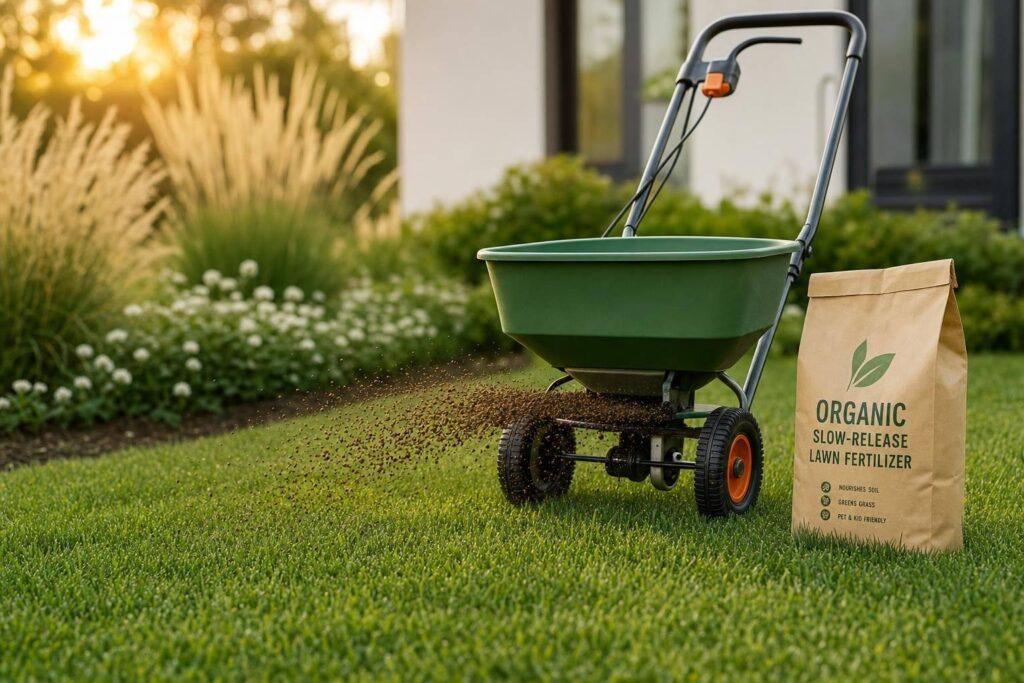
Organic lawn fertilizer feeds the soil first, then the grass. That means slower color, lower burn risk, and more steady growth over time.
If I wanted to sum up the whole topic fast, I’d put it like this:
- Organic fertilizers release nutrients slowly through soil microbes, not all at once
- Common types include compost, biosolids, plant meals, corn gluten meal, animal meals, fish products, and kelp
- Most lawns need about 1 pound of nitrogen per 1,000 sq. ft. per feeding
- Visible greening often takes 1–2 weeks, instead of 3–5 days with synthetic products
- Many organic programs use 3–4 feedings per growing season
- Milorganite-type biosolids can feed for 8–10 weeks
- Grasscycling can cut fertilizer needs by up to 30%
- A full shift to an organic program often takes 1–2 growing seasons
If you’re choosing between products, I’d think about three things first: nutrient strength, release speed, and whether the product is mostly for soil building or routine feeding.
| Type | Typical N-P-K | Main use | Speed |
|---|---|---|---|
| Compost or manure | 1-1-1 to 5-3-2 | Soil building, lawn recovery | Very slow |
| Biosolids | 6-4-0 | Routine feeding, darker color | Slow |
| Plant meals | 7-0-0 to 10-0-2 | Regular feeding | Moderate to slow |
| Corn gluten meal | 9-0-0 to 10-0-0 | Spring feeding + possible crabgrass suppression | Slow |
| Animal meals | 8-3-5 to 11-2-2 | New seed, sod, nutrient gaps | Slow |
| Fish or kelp | 0-0-1 to 5-3-0 | Micronutrients, stress support | Fast if liquid |
I’d also keep the trade-off simple: you give up fast results, but you get lower burn risk, better soil condition, and a steadier feeding pattern. The best results usually come from a soil test, the right timing for your grass type, even spreading, light watering of 1/4 to 1/2 inch, and core aeration if the soil is compacted.
That’s the big picture of the article in plain English.
Types of Organic Lawn Fertilizers and How They Compare
The main differences come down to nutrient strength, how fast they feed, and whether they mainly build soil or feed grass more directly.
Compost, manure-based, and biosolid fertilizers
Compost and composted manures usually have modest nutrient numbers, often around 1-1-1 to 5-3-2 N-P-K. Their biggest plus isn’t raw feeding power. It’s what they do for the soil.
Used as a topdressing on thin turf or during lawn recovery, they add organic matter that helps soil structure and improves water retention. That can make a tired lawn easier to manage over time, especially if the soil feels hard, dry, or worn out.
If soil building isn’t the main goal, plant-based meals usually make more sense because they supply nitrogen more directly.
Biosolid fertilizers like Milorganite (6-4-0) sit in the middle. They’re made from treated municipal biosolids and supply slow-release nitrogen along with iron for darker color. Milorganite releases nitrogen over 8 to 10 weeks and contains about 2.5% iron, which helps green up the lawn without the burn risk tied to faster-acting products.
Plant-based and marine-derived fertilizers
Plant-based meals like alfalfa meal, soybean meal, and cottonseed meal are solid choices for routine feeding. They’re usually granular and often land in the 7-0-0 to 10-0-2 range. Soil microbes break them down at a fairly steady pace, so they work well in regular lawn care programs.
Corn gluten meal (9-0-0 to 10-0-0) is a bit different. It may help suppress crabgrass germination, which gives it a second job beyond feeding the lawn. Applied in early spring when soil temperatures reach about 55°F, it can act as both a nitrogen source and a seasonal weed-control tool.
Marine-derived products like fish emulsion, fish hydrolysate, and kelp play a different role. Their N-P-K numbers are low – sometimes as low as 0-0-1 for kelp – so they’re usually better as supplements than as the main fertilizer source. Where they help most is with micronutrients and helping grass deal with heat or drought stress.
Fertilizer types compared: N-P-K range, release speed, and best use
Use the table below to compare each type at a glance.
| Fertilizer Type | Typical N-P-K | Form | Release Speed | Best Use |
|---|---|---|---|---|
| Compost / Manure | 1-1-1 to 5-3-2 | Topdressing / Bulk | Very slow | Soil building, thin turf recovery |
| Biosolids (e.g., Milorganite) | 6-4-0 | Granular | Slow (8–10 weeks) | Routine feeding, deep greening |
| Plant-based meal (soy, alfalfa) | 7-0-0 to 10-0-2 | Granular | Moderate / slow | Routine feeding, low-odor programs |
| Corn gluten meal | 9-0-0 to 10-0-0 | Granular | Slow | Spring weed prevention + nitrogen |
| Animal meal (blood, feather, bone) | 8-3-5 to 11-2-2 | Granular | Slow | New seed or sod, P & K deficiencies |
| Marine / fish (kelp, emulsion) | 0-0-1 to 5-3-0 | Liquid / Meal | Fast (liquid) | Micronutrient support, stress recovery |
sbb-itb-5aa6250
Benefits and Trade-Offs of Organic Fertilizers

Organic vs. Synthetic Lawn Fertilizers: Full Comparison Guide
Soil health, safety, and steady nutrient release
After you compare fertilizer types, the next step is simple: look at the trade-offs.
Organic fertilizers improve the soil first, and that supports long-term lawn health. Organic programs support more microbial activity than synthetic-only feeding, which helps lawns get tougher over time. More soil organic matter also helps the ground hold water better and deal with dry spells.
Another plus is safety. Because organic nitrogen doesn’t hit the lawn as a fast-acting mineral salt, the risk of fertilizer burn is very low. Many organic products also allow faster re-entry than synthetic fertilizers, which matters if kids or pets use the yard.
The catch? You usually won’t see instant color.
Slower results, higher cost per pound of nitrogen, and timing limits
The trade-offs are real, and it’s better to know them upfront.
Visible greening usually takes one to two weeks with organic products. With synthetics, it often happens in three to five days. So if you want fast color, organic fertilizers usually aren’t the best fit.
Cost matters too. Organic nitrogen usually costs more per pound than synthetic nitrogen. Timing can also be a little trickier. Nutrient release depends on soil temperature and microbial activity, so putting it down too early in spring, when soil is still cold, can slow the breakdown process.
Most organic programs need three to four applications per growing season to keep feeding steady. And if smell is a deal-breaker, pay attention to the ingredient source. Manure- or biosolid-based products can have a clear earthy odor for several days. Soy-based options are usually low-odor.
Switching from synthetic to organic takes patience as well. A full soil response can take one to two growing seasons.
Because nutrient release depends on soil conditions, rate and timing matter more than they do with synthetics.
Organic vs. synthetic lawn fertilizers: side-by-side comparison
| Feature | Organic Fertilizers | Synthetic Fertilizers |
|---|---|---|
| Speed of visible results | 1–2 weeks | 3–5 days |
| Cost per lb. of nitrogen | Higher | Lower upfront |
| Soil health impact | Builds structure and microbial life | Can lower pH and reduce microbial diversity |
| Burn risk | Very low | Higher if over-applied or applied to dry grass |
| Runoff potential | Low (nutrients stay bound to organic matter) | High (water-soluble; leaches easily) |
| Safety for kids and pets | Generally safe with faster re-entry | Often requires a waiting period |
Choosing the right product and schedule is what makes these upsides work in practice.
How to Choose and Apply Organic Lawn Fertilizer
Start with a soil test and lawn assessment
Once you know which organic fertilizer fits your lawn, the next move is simple: apply it at the right rate and at the right time. That matters even more with organic products because they work best when the soil supports microbial activity.
Before you buy anything, test your soil. A basic soil test shows your pH and points out any nutrient gaps. For most lawns, the ideal pH range is 5.8 to 7.2. If your soil falls outside that range, grass can’t take up nutrients as well, even if you’re using a solid organic fertilizer.
A soil test can also save you money on phosphorus. Don’t add it unless the test says you need it. If phosphorus levels are already fine, choose a fertilizer with a zero in the middle number, like 10-0-6 or 8-0-5.
While you’re at it, inspect the lawn itself. Look for pooling water and hard soil. If the ground is compacted, core aerate before fertilizing.
Read the label, calculate the rate, and time applications by season
With organic fertilizers, slow release changes the game a bit. You can’t just toss some down and hope for the best. Rate and timing carry more weight than they often do with synthetic products.
The three numbers on the bag show N-P-K: nitrogen, phosphorus, and potassium by weight. Organic fertilizers often have lower numbers because they aren’t as concentrated and they release nutrients slowly.
For each feeding, apply 1 pound of nitrogen per 1,000 sq. ft. To figure out how much product you need, divide 100 by the first N number.
- A 10-0-6 fertilizer needs 10 lbs. of product per 1,000 sq. ft.
- A 5-3-2 fertilizer needs 20 lbs.
That’s why it helps to know your lawn’s square footage before you shop. It keeps you from buying too little or ending up with extra bags you didn’t need.
Timing depends on the type of grass you have. Cool-season grasses, like fescue, ryegrass, and Kentucky bluegrass, do best with the heaviest feeding in early fall, plus a lighter spring application. Warm-season grasses, like Bermuda, Zoysia, and St. Augustine, should be fed from late spring through summer, when they’re actively growing.
Apply evenly and pair fertilizing with mowing, watering, and aeration
When it’s time to spread the fertilizer, aim for even coverage and follow with light watering.
Use a broadcast or drop spreader. Hand-spreading usually leads to streaks, missed spots, and uneven growth. A good way to even things out is to set the spreader to half rate and make two passes in different directions: one north-to-south and one east-to-west. That two-pass method helps cover the lawn evenly without dumping too much in one area.
Afterward, water lightly with 1/4 to 1/2 inch of water.
Your mowing habits matter too. Stick to the one-third rule: never remove more than one-third of the grass blade at one time. And don’t toss those short clippings. Leaving them on the lawn, a practice called grasscycling, can cut fertilizer needs by as much as 30% because the clippings return nitrogen and organic matter to the soil.
If the soil is compacted, core aerate before fertilizing so nutrients can reach the root zone.
Building a Long-Term Organic Lawn Program
Create a seasonal plan and adjust based on lawn response
Organic fertilization works more like a cycle than a one-and-done fix. After you apply the product, the work shifts to steady care through the year.
| Season | Primary Actions |
|---|---|
| Spring | Soil test, light feeding, use corn gluten meal for early-spring nitrogen and possible crabgrass suppression |
| Summer | Deep watering, spot-treat weeds, feed warm-season grasses only |
| Fall | Core aeration, overseeding, main feeding window |
| Winter | Equipment maintenance, minimal foot traffic |
Don’t rely on the calendar by itself. Watch how the lawn responds, then decide what to do next.
Look for signs like:
- Deeper green color
- Better turf density
- Thatch buildup
- Weed pressure from one season to the next
A follow-up soil test every one to two years can show whether your pH, nutrient levels, and organic matter are moving in the right direction.
Even with a steady schedule, organic programs need time. You may see change in a few weeks, but a full shift usually takes one to two growing seasons. If the lawn starts off in poor shape, it can take longer.
Long-term progress comes from repeated soil-building, not from fertilizer alone. A light compost topdressing once a year can help soil structure and support microbes.
When to bring in professional lawn care support
If you’re dealing with a big property or a major lawn rehab, pro help can make life a lot easier. It can take the guesswork out of aeration, overseeding, and application rate calculations.
Key takeaways for choosing organic lawn fertilizers
Organic fertilizers feed the grass while also helping the soil below it. Start with a soil test, then stick to a steady seasonal schedule based on your grass type. That’s the base of a lawn program that improves year after year.
FAQs
Which organic fertilizer is best for my lawn?
There isn’t one best organic fertilizer for every lawn. The right pick depends on your soil, your grass type, and your soil test results.
For most home lawns, a high-quality granular organic fertilizer is a solid option. It feeds the grass slowly instead of all at once, and it can help improve soil health over time.
When you shop, check the label for natural ingredients like alfalfa meal, feather meal, bone meal, or composted organic matter.
Can I switch from synthetic to organic fertilizer right away?
Yes, but the switch is usually gradual, not immediate.
Organic fertilizer feeds the soil life first, instead of giving your lawn a fast shot of nutrients. That means the change takes time. For most lawns, the shift takes about 2 to 3 years, though a lawn that’s already in great shape may adjust faster.
During that stretch, you may notice a small uptick in weeds or a short-term drop in density. That can feel frustrating at first, but it’s a normal part of the process.
How long does it take organic fertilizer to work?
Organic fertilizer doesn’t work all at once. It feeds the lawn bit by bit because soil microbes need time to break down the nutrients before grass can use them.
That said, you can usually expect a deeper green color within 1 to 2 weeks.
Here’s the usual timing:
- Granular formulas often start working in 10 to 12 days
- Liquid organics may show results in 4 to 5 days
After that, they keep feeding the lawn at a steady pace for 8 to 10 weeks.