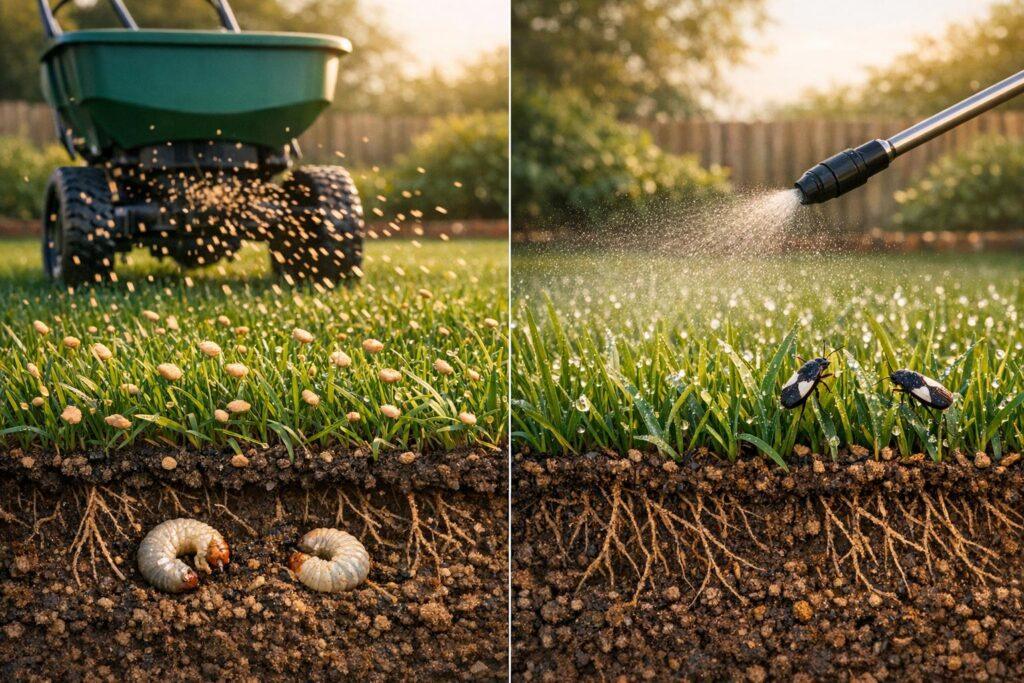
When tackling lawn pests, your choice between granular and liquid insecticides matters. Each type has specific strengths and weaknesses depending on the pest, lawn condition, and application method. Here’s what you need to know:
- Liquid insecticides: Fast-acting and ideal for surface pests like chinch bugs and sod webworms. They provide quick knockdowns, even coverage, and can be mixed with other lawn care products. However, they require precise mixing, are prone to drift in windy conditions, and need careful timing for application.
- Granular insecticides: Best for soil-dwelling pests like grubs and ants, offering long-lasting protection through slow-release formulas. They’re easy to apply, less affected by wind, and safe for nearby plants. But they must be watered in to activate and are ineffective for pests on grass blades.
Quick Comparison:
| Feature | Liquid Insecticides | Granular Insecticides |
|---|---|---|
| Best For | Surface pests | Soil-dwelling pests |
| Application | Sprayed (requires mixing) | Spread (ready-to-use) |
| Activation | Immediate (contact/systemic) | Requires watering-in |
| Coverage | Even distribution | Focused on soil |
| Weather Sensitivity | Drift in wind; avoid heat | Minimal drift; needs moisture |
| Protection Duration | 30–90 days | Weeks to months |
For quick, targeted pest control, go with liquid. For preventive, long-term solutions, granular is your answer. Timing, weather, and proper application are key to success.
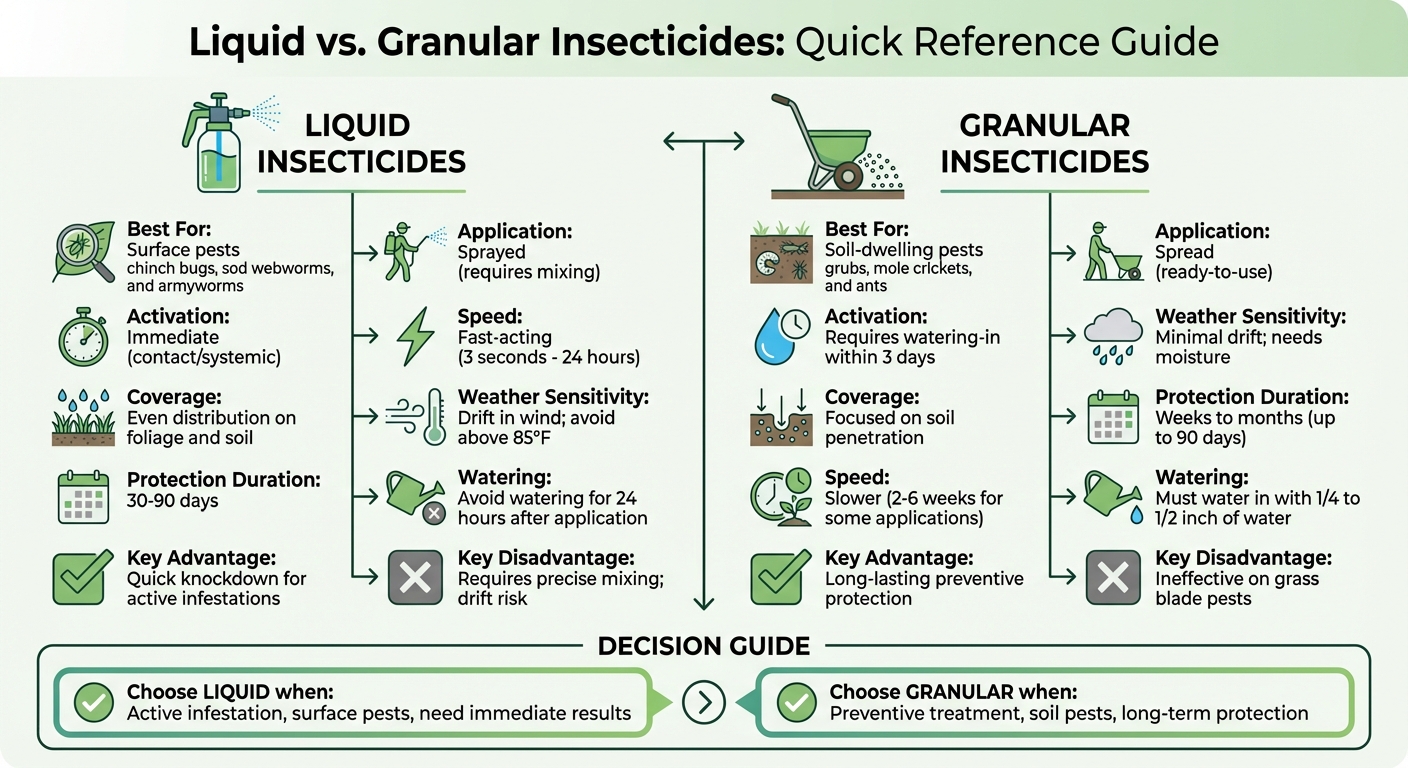
Liquid vs Granular Insecticides Comparison Chart for Lawn Pest Control
How Liquid Insecticides Work
Liquid insecticides are designed to deliver active ingredients directly to pests through a spray application. They act quickly, either by direct contact with the pest or through absorption by plants. Their concentrated formulas ensure rapid results. Here’s a closer look at how they’re applied and how they work on a molecular level.
Application Method
To prepare the mixture, start by filling your sprayer halfway with water, then add the concentrate, and finish by filling it completely and mixing thoroughly. Professionals often rely on backpack or handheld sprayers, especially for residential lawns.
For consistent results, walk in straight, even rows across your lawn, ensuring uniform coverage. Adding a spray indicator dye to your tank can help you see where you’ve already sprayed, preventing missed spots or overlapping. Use flat-fan nozzles set at 30–60 psi to achieve an even application.
Timing matters. The best times to apply are early in the morning or after sunset. Avoid spraying during windy conditions or when temperatures exceed 85°F to minimize drift caused by small droplets.
Mode of Action
Liquid insecticides work through two main mechanisms: contact kill and systemic action. Contact formulations kill pests immediately upon contact with treated surfaces. Systemic insecticides, on the other hand, are absorbed by plants through their foliage or roots, targeting pests that feed on the treated areas.
Many professional-grade liquid insecticides provide residual protection for 30 to 90 days, continuing to guard against pests that may appear after the initial application. Some advanced formulations even feature polymer layers that shield the active ingredients from weather and irrigation, extending their effectiveness. This makes liquid insecticides especially effective against foliar pests like chinch bugs and sod webworms, as they coat the thatch and foliage where these insects are most active. Their fast-acting, dual-action capabilities distinguish liquid insecticides, setting the stage for a comparison with granular alternatives.
sbb-itb-5aa6250
How Granular Insecticides Work
Granular insecticides offer a soil-focused approach that’s quite different from liquid sprays. Instead of applying a liquid solution, you spread granules across your lawn. These granules are designed to deliver precise pest control. The active ingredient, which makes up about 1% to 15% of the granule’s weight, is either coated onto or absorbed into a carrier material. Common carriers include clay, walnut shells, or corn cob pieces, all chosen for their porous nature.
Application Process
Using granular insecticides is simple and doesn’t involve mixing or diluting. To apply, use a broadcast or push spreader, moving in overlapping rows to ensure complete coverage. It’s crucial to calibrate the spreader according to the instructions on the product label, as the granule size – ranging from tiny sand-like particles to larger pebbles – affects how the material flows through the spreader.
The most important step is watering in the granules. This can be done either with irrigation or by relying on natural rainfall within three days of application. Watering activates the insecticide, allowing it to start penetrating the soil.
"Most granular products need to be watered in (meaning the lawn should be wet down) to release the active ingredient of the granules in the lawn." – DoMyOwn
Soil Interaction
Once activated by water, the granules release their active ingredient, which moves into the soil. This is where granular insecticides shine, targeting pests like grubs, mole crickets, and ants that live below the surface. Their weight helps them bypass dense grass and thick thatch layers, unlike liquid sprays, which can get caught on foliage.
The design of these products allows for a slow release of the active ingredient, providing extended protection that can last weeks or even months. However, this gradual process depends on consistent soil moisture. In drought conditions, insufficient water might limit the release of the insecticide, reducing its effectiveness against pests.
Liquid Insecticides: Pros and Cons
When it comes to liquid insecticides, they offer both clear advantages and some challenges. Here’s a closer look at what makes them effective, as well as the potential drawbacks.
Key Advantages
Liquid insecticides are known for their speed. They act immediately on contact, making them ideal for urgent pest problems. For pests like chinch bugs that live on the surface, liquid products can penetrate directly to the crown area where these insects gather, delivering quick results.
Their coverage is another strong point. Liquid applications ensure even distribution across foliage and soil, including hard-to-reach spots like the undersides of grass blades and plant surfaces where pests often hide. This thorough coverage enhances their effectiveness.
Cost-efficiency is another benefit. Because liquids come in concentrated forms, you only mix what you need, making them economical over larger areas. They also take up less storage space compared to bulky granular products. Plus, liquid insecticides can be tank-mixed with fertilizers or surfactants, allowing you to handle multiple tasks in one application, saving both time and effort.
Key Disadvantages
However, liquid insecticides come with challenges. One of the biggest issues is drift – wind can carry spray droplets to unintended areas, possibly damaging nearby plants or over-seeded lawns. This means they can’t be applied on windy days or in temperatures over 85°F, limiting when you can use them. Smaller droplets (under 150 microns) are particularly prone to drift, while larger droplets are less likely to evaporate.
Mixing and dilution can also be tricky. Most liquid products require precise measuring and mixing with water. Errors in this process can lead to wasted product or reduced effectiveness. Cristi Palmer, Turf and Ornamental Product Manager at FMC Agricultural Product Group, points out:
"A disadvantage to using liquid is that the product may be more difficult to contain in case of a spill. Ensuring the appropriate dilution for small volumes can also be more difficult."
Another concern is user exposure. The mixing and application process requires protective gear like gloves, long sleeves, and masks to reduce risks. Pre-mixed, ready-to-use products are an option, but they can lose up to 50% of their effectiveness since the active ingredients start breaking down once water is added. Lastly, you’ll need specialized equipment – such as hand-pump, backpack, or ATV sprayers – which must be cleaned thoroughly after each use to avoid contamination.
Comparison Table
| Advantage | Disadvantage |
|---|---|
| Fast-acting; immediate contact kill | High risk of drift in windy conditions |
| Superior, even coverage on foliage and soil | Requires precise mixing and dilution |
| Cost-effective; concentrates go further | Needs specialized sprayer equipment |
| Can tank-mix with fertilizers and other products | Higher user exposure during application |
| Minimal storage space required | Application limited by weather and temperature |
| Pre-mixed products lose 50% effectiveness |
Granular Insecticides: Pros and Cons
Granular insecticides offer a straightforward, no-fuss approach compared to liquid options. They come with distinct strengths and weaknesses, so knowing both can help you decide when they’re the right fit for your lawn care needs.
Key Advantages
One of the biggest perks of granular insecticides is their ease of use. Since they come ready-to-apply straight out of the bag, there’s no need for mixing or measuring, which saves time and reduces the chance of errors. Cristi Palmer from FMC Agricultural Product Group highlights this benefit:
"Often, granular materials, being ready-to-use, offer an appealing savings in time and preparation."
Another advantage is their minimal drift. Unlike liquid sprays, granules are heavier and settle quickly, staying exactly where you apply them. This makes them a safer option for nearby plants, flower beds, and even your neighbors’ yards. As Nicole Wisniewski, Associate Editor at Lawn & Landscape, points out:
"The public perceives granular materials as less threatening to nontarget organisms."
Granular insecticides also provide long-lasting protection. Their slow-release formula ensures extended pest control, which can be especially effective for ground-dwelling pests like ants, crickets, and mole crickets. The granules easily penetrate dense grass to reach the soil surface where these pests live. Plus, the equipment needed – like a drop or rotary spreader – is simple and requires less upkeep compared to power sprayers.
Key Disadvantages
However, granular insecticides do have their downsides. For starters, they need water to activate. Without irrigation or rainfall within about three days, the granules just sit on the soil and won’t work. As Frederick M. Fishel, Professor at the University of Florida IFAS, explains:
"Granules… may not be effective under drought conditions because the active ingredient is not released in sufficient quantity to control the pest."
These products are also limited to soil-dwelling pests. Since granules don’t stick to grass blades, they’re ineffective against pests that live or feed on foliage, making liquid sprays a better choice for those situations. Additionally, spreaders need to be recalibrated for each product to account for differences in granule size, weight, and density, which can lead to uneven application if not done correctly.
Another concern is the potential risk to pets and wildlife. If the granules aren’t watered in right away, they could be ingested, posing a safety hazard.
Comparison Table
| Advantage | Disadvantage |
|---|---|
| Ready-to-use; no mixing required | Requires watering-in to activate |
| Minimal drift; safe in windy conditions | Ineffective for pests on grass blades |
| Long-lasting protection via slow-release | Slower initial pest control |
| Easily reaches soil-dwelling pests | Spreaders require careful calibration |
| Simple equipment with low maintenance | Ineffective during drought conditions |
| Safer application in moderate wind | Risk of ingestion by pets and wildlife |
When to Use Each Type of Insecticide
Deciding between liquid and granular insecticides depends on the situation and your specific pest control needs. Liquids are best for quick knockdowns, while granular products shine in preventive soil treatments.
When to Use Liquid Insecticides
Liquid insecticides are your go-to option when dealing with an active infestation that demands immediate attention. If chinch bugs, armyworms, or sod webworms are visibly damaging your lawn, liquids act fast – often taking effect within 3 seconds to 24 hours of contact. These pests typically feed on grass blades and plant juices, making liquid sprays ideal for thorough coverage of the crown and stems.
Bob Andrews, President of Greenskeeper, shares his professional insight:
"We like to use the liquid program in the spring (April, May and early June) and fall (September, October and mid-November). Those are the best times for us to get weed control, and we like to do that with liquid applications."
Liquids are also highly effective in summer for combating surface-feeding pests. For example, liquid drenches are the preferred method for quickly eliminating fire ant mounds.
To maximize effectiveness, apply liquids early in the morning or late in the afternoon on calm, dry days. This reduces evaporation and prevents drift. However, avoid applying liquids if heavy rain is expected, as it can wash away the product before it has time to work.
While liquids are perfect for quick action, granular insecticides provide longer-lasting protection.
When to Use Granular Insecticides
Granular insecticides are best suited for preventive treatments and targeting soil-dwelling pests like white grubs, mole crickets, and ants. In the spring, when soil temperatures reach 55°F, granular pre-emergents can stop grubs before they hatch and begin feeding on roots. As EPM Earth explains:
"In spring, the goal is prevention – targeting pests like grubs in your lawn before they hatch and begin feeding. Pre-emergent insecticides work best when soil temperatures reach about 55°F."
For broader fire ant control across your entire lawn, granular baits are highly effective. Applied two to three times per year, they can achieve 80% to 90% colony elimination, although results may take 2 to 6 weeks. For best results, apply granular baits in the late afternoon during summer or fall when ground temperatures range between 70°F and 90°F.
Granular insecticides are ideal for large-scale applications requiring extended protection, with some products offering residual effects for up to 90 days. They’re also a better choice in windy conditions, as drift isn’t a concern. Always water in granulars immediately after application (using 1/4 to 1/2 inch of water) to activate the product. Mowing your lawn beforehand helps the granules penetrate the soil more effectively.
Application Tips and Best Practices
Getting the application right is crucial for effective pest control and avoiding wasted product. Here’s how to apply both liquid and granular insecticides properly.
Timing and Weather Considerations
Temperature and time of day play a big role when applying liquid insecticides. The best times are early morning or after sunset to prevent turf damage. Avoid spraying when temperatures climb above 85°F, as the heat can cause the product to evaporate before it reaches the pests. Most liquid products become rainfast in about 15 to 30 minutes once dried, so check the weather forecast – heavy rain right after application can wash away the treatment before it bonds with the grass.
Granular insecticides, on the other hand, aren’t as affected by temperature or time of day. However, they do require moisture to activate. Light rain within three days of application works just as well as manual watering to get the job done.
Once you’ve nailed the timing, the next step is ensuring an even application for thorough coverage.
Coverage and Consistency
Even distribution is key. For liquid insecticides, walk in straight, parallel lines, overlapping your spray pattern by 30% to 50% on each pass. Robert "Bobby" Grisso, an Extension Engineer at Virginia Tech, recommends keeping spray pressures below 40 psi. This helps prevent fine droplets from drifting or evaporating before they hit their target.
For granular products, aim for a crisscross pattern by making two passes at right angles to each other. If you’re using a push spreader, align each pass so the granules land back in the tire marks from your previous row. As Solutions Pest & Lawn emphasizes:
"It is crucial to read the label before applying granular pesticides. This will not only give you the proper rate but also let you know the proper calibration setting for the particular pesticide granules you will be spreading."
After achieving even coverage, proper watering is the final step to lock in the treatment.
Watering Requirements
Watering is a critical part of the process. Granular insecticides need moisture to release their active ingredients. Make sure to water them within three days of application; without this step, the granules will just sit on the surface, inactive.
For liquid insecticides, drying time is essential. These products need to dry on grass blades and stems to be effective. Avoid watering or exposing the area to rain for at least 24 hours after application. Never apply liquids to wet surfaces, as this can lead to runoff or wash away the treatment. Once the spray has dried completely (about 24 hours), the area can be safely reoccupied.
Conclusion
For quick control of surface pests, liquid insecticides are ideal; for long-term soil pest management, granular products are the way to go. Liquid sprays are highly effective against surface pests like chinch bugs and sod webworms, delivering fast results. On the other hand, granular formulations are better suited for soil-dwelling pests like grubs and ants, as they release their active ingredients gradually, offering extended protection.
When using liquid sprays, it’s important to apply them in calm weather below 85°F to avoid drift. Granular products, however, need moisture to activate and release their ingredients effectively. As Tim Doppel, President of Atwood Lawn Care, explains:
"IPM requires the applicator to think. Once the decision to make an application has been made, the applicator should choose the best product and the best method of application to do the job."
Proper pest identification and timing are critical to success. Correctly identifying the pest not only avoids unnecessary treatments but also prevents turf damage and pest resurgence. Timing applications to target the most vulnerable life stage of the pest – such as young larvae – can achieve over 90% control when done right.
For those who prefer professional care, Dependable Lawn Care offers tailored programs to keep your lawn in top shape. Their Bronze, Silver, and Gold plans combine weed control and fertilization, ensuring year-round health. Professional applicators bring the expertise, specialized equipment, and knowledge of pest behavior needed to apply treatments safely and effectively.
FAQs
When is the best time to apply liquid insecticides to your lawn?
Liquid insecticides are most effective when applied during calm, dry weather. Ideally, there should be no rain forecasted for at least 24 hours to allow the product to remain on the lawn long enough to do its job. For the best outcome, target times when pests are actively feeding or visible, as this increases their exposure to the treatment.
Morning or evening applications are often the best choice. Cooler temperatures and lighter winds during these times help minimize evaporation or drift, ensuring the insecticide stays where it’s needed. Always carefully follow the instructions on the product label for safe and effective use.
How do granular insecticides work, and how long do they remain effective?
Granular insecticides function by delivering their active ingredient into the soil, where pests either consume it or come into contact with it. Typically, these granules activate upon exposure to water, such as from rain or irrigation.
The duration of their effectiveness varies, ranging from a few weeks to several months. This depends on factors like the specific insecticide, weather conditions, and how active pests are in your lawn. To get the best results, consistent monitoring and correct application are essential.
Can I mix liquid insecticides with other lawn care products safely?
Yes, you can combine liquid insecticides with other lawn care products, but it’s crucial to make sure they’re compatible. Start by carefully reading the product labels for any warnings or restrictions. A quick jar test can help you check if the products mix well without separating, clogging your equipment, or causing unwanted chemical reactions.
To minimize problems, stick to the recommended mixing order listed on the labels and use clean equipment. This not only protects your tools but also ensures the products work as intended. Always prioritize safety by following the manufacturer’s instructions closely.