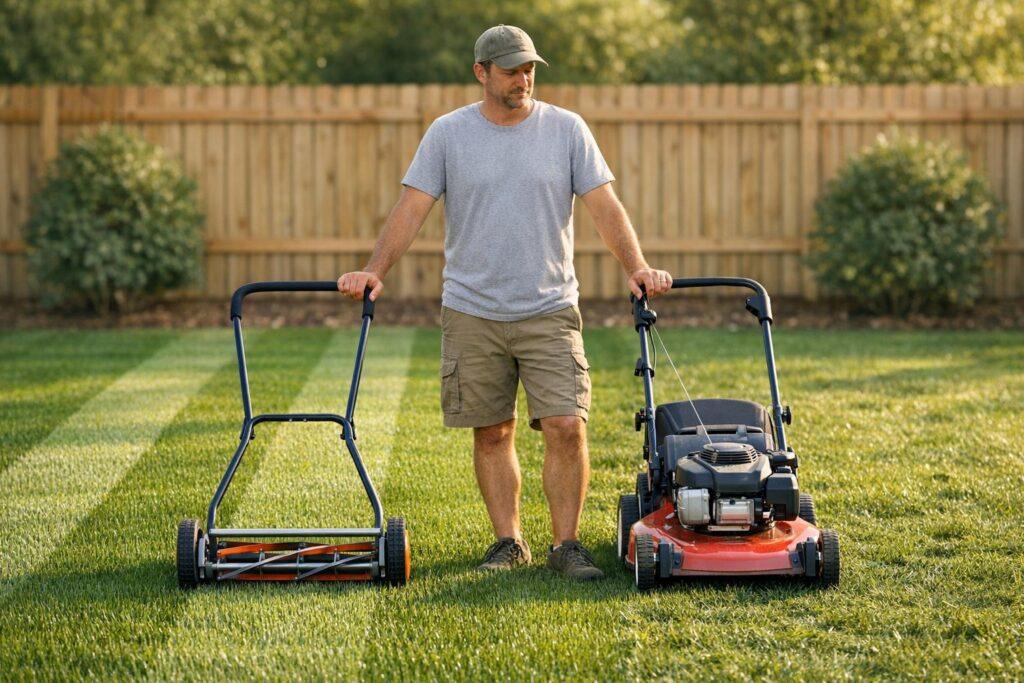
Choosing between rotary and reel mowers depends on your lawn’s size, grass type, and terrain. Reel mowers are best for small, flat yards with fine grasses like Bermuda or Zoysia, delivering a precise, scissor-like cut. However, they require frequent lawn mowing and struggle with uneven surfaces or debris. Rotary mowers are more versatile, handling larger lawns, rough terrain, and taller grasses like St. Augustine or Fescue, but they need more maintenance and can be less gentle on grass.
Key Takeaways:
- Reel Mowers: Ideal for small, flat lawns (under 5,000 sq. ft.) with short, fine grass. Quiet, eco-friendly, and low-maintenance but slower and labor-intensive.
- Rotary Mowers: Better for larger lawns, uneven ground, and coarse grasses. Faster, more powerful, and versatile but noisier and requires regular upkeep.
Quick Comparison
| Feature | Reel Mower | Rotary Mower |
|---|---|---|
| Cutting Action | Scissor-like shear | High-speed chopping |
| Best Grass Height | 0.5–2 inches | 1.5–4+ inches |
| Lawn Size | Up to 5,000 sq. ft. | 5,000+ sq. ft. |
| Terrain | Flat, even surfaces | Handles rough terrain |
| Noise Level | Quiet | Noisier (70–105 dB) |
| Cost (10 Years) | $200–$400 | $800–$2,500+ |
Your choice boils down to your lawn care needs and how much effort you’re willing to invest.

Rotary vs Reel Mowers Comparison Chart: Features, Costs, and Performance
Rotary Mowers: How They Work and What to Expect
How Rotary Mowers Work
Rotary mowers use a straightforward yet effective design. A horizontal blade spins on a vertical axle at around 3,000 RPM, cutting grass through sheer speed and impact. This rapid motion also generates an updraft, pulling the grass upright for a cleaner cut. It’s a completely different approach compared to the precise, scissor-like action of reel mowers.
You’ll find rotary mowers in three main types: gas-powered, battery-powered, and corded electric models. Walk-behind versions typically weigh between 50 and 150 pounds and allow you to adjust cutting heights from 1.5 to over 4 inches. Their four-wheel design and adjustable deck height make them a practical choice for various lawn conditions.
Benefits of Rotary Mowers
Rotary mowers excel where reel mowers fall short. They can tackle taller grass (over 2 inches), thick patches, weeds, and even small twigs with ease. Their adjustable wheels make them ideal for handling uneven terrain, bumps, and slopes, reducing the risk of scalping your lawn. In terms of coverage, rotary mowers can handle 0.2 to 0.5 acres per hour, outpacing the 0.1 to 0.3 acres typically managed by manual reel mowers.
These mowers also cater to a wide range of budgets and yard sizes. Push models are priced between $110 and $840, self-propelled versions range from $260 to $2,070, and riding mowers can cost anywhere from $1,200 to $6,000.
Drawbacks of Rotary Mowers
While rotary mowers are versatile, they do have some downsides. Their high-speed blades can fray grass tips rather than cutting them cleanly, potentially stressing your lawn and increasing its vulnerability to disease. Sharpening the blades regularly – about every 20 to 25 hours of use – can help, but the cut won’t be as precise as what you’d get with a reel mower.
Maintenance is another factor to consider. Gas models require oil changes every 50 hours, air filter cleaning every 25 hours, and spark plug replacements every 100 hours. These maintenance tasks can add up, with annual costs ranging from $50 to $150 for gas mowers and $40 to $80 for electric ones.
Noise levels are also worth noting. Gas-powered rotary mowers are quite loud, operating at 95 to 105 decibels, while electric models are quieter, running at 70 to 75 decibels. Additionally, gas mowers produce emissions comparable to driving a car 45 miles for every hour of use, which might be a concern for environmentally conscious users.
sbb-itb-5aa6250
Reel Mowers: How They Work and What to Expect
How Reel Mowers Work
Reel mowers operate in a way that’s quite different from the more common rotary mowers. Instead of spinning a single blade at high speeds, these mowers use 5–7 helical blades mounted on a rotating cylinder. As you push the mower forward, the blades trap the grass against a fixed bedknife, cutting it cleanly – much like a pair of scissors. The cylinder lifts and positions the grass for a precise, uniform cut.
Manual reel mowers, which weigh between 17 and 35 pounds, are light and easy to handle for smaller yards. Gas-powered models, on the other hand, spin their blades at 2,000–2,500 RPM, offering more power for a similarly clean cut.
For the best results, reel mowers require grass to stay between 0.5 and 2 inches in height. They’re particularly effective on warm-season grasses like Bermuda and Zoysia, which grow well when kept short. However, if your grass grows taller than 4 inches, the reel mechanism struggles to catch and cut it properly.
Understanding their mechanics shows why reel mowers are known for delivering a precise and professional-looking cut. Let’s take a closer look at the benefits they offer.
Benefits of Reel Mowers
The standout feature of reel mowers is their ability to deliver a clean, precise cut. Unlike rotary mowers that tear grass, reel mowers slice each blade individually. This scissor-like action seals the grass tips, helping the lawn retain moisture and resist disease. Lawn care expert Oliver Grantson puts it this way:
"The clean scissor cut seals the grass blade tip, which keeps moisture in and disease out. Your lawn stays greener longer."
Another big plus? Manual reel mowers are virtually silent, so you can mow early in the morning without waking the neighborhood. They also produce zero emissions, making them an eco-friendly choice. Starting at around $129 and requiring minimal upkeep – like annual blade sharpening and alignment – they’re budget-friendly in the long run. Premium models, such as the Fiskars StaySharp Max, range from $280 to $310 and come with added durability and features.
Using a manual reel mower even doubles as light exercise, burning between 165 and 198 calories in just 30 minutes of mowing.
Drawbacks of Reel Mowers
Despite their perks, reel mowers come with some limitations that may not suit every homeowner. They’re ideal for lawns under 5,000 square feet, although some enthusiasts claim they can manage up to 8,000 square feet – but the physical effort required beyond that can be daunting. With a mowing speed of 0.1–0.3 acres per hour, they’re significantly slower than rotary mowers.
Reel mowers also perform best on flat, even terrain. Uneven or sloped lawns can cause them to scalp high spots or miss low ones entirely. Plus, they’re not designed to handle obstacles like twigs, stones, or thick weeds, which can jam the blades. Regular mowing every 4–7 days is necessary during peak growth to prevent clogging.
Wet grass poses another challenge. Moisture causes clippings to clump together, clogging the blades and preventing a clean cut. For the best results, you’ll need to wait for dry conditions before mowing. And if the blades become dull or misaligned, they’ll bend the grass instead of cutting it. Sharpening the blades costs about $75 professionally, though you can opt for a $30 DIY kit to save money.
Cutting Quality, Lawn Size, and Terrain: A Direct Comparison
Let’s break down how reel and rotary mowers perform under different conditions. This overview highlights key differences in cutting quality, lawn size suitability, and terrain handling to help you decide which one fits your needs best.
Cutting quality
Reel mowers deliver a clean, precise cut by slicing grass like scissors. This helps seal the grass tips, retaining moisture and reducing the risk of disease. On the other hand, rotary mowers rely on high-speed blades spinning at around 3,000 RPM, which chop the grass. This chopping action can leave grass torn, leading to browning and additional stress, especially if the blades are dull. Reel mowers shine on warm-season grasses trimmed to 0.5–1.5 inches, while rotary mowers are better suited for taller grasses like St. Augustine, typically maintained between 2.5–4 inches, and for mixed vegetation that might clog a reel mower.
Lawn size matters too:
Reel mowers are ideal for smaller lawns, typically those under 5,000 square feet. While some users manage up to 8,000 square feet, it requires significant effort, making them less practical for larger properties. Rotary mowers, on the other hand, are better equipped for medium to large lawns. For areas larger than 1/4 acre (about 10,890 square feet), riding or zero-turn rotary mowers become necessary to cover the space efficiently.
Terrain handling is another key difference. Reel mowers work best on flat, even lawns and struggle with uneven ground. In contrast, rotary mowers are built to tackle bumpy terrain, slopes, and ruts with ease. Their four-wheel design and adjustable deck heights make them versatile for various landscapes. Additionally, rotary mowers can handle debris like twigs or small rocks without jamming, whereas reel mowers can get stuck easily. As lawn care expert Oliver Grantson explains:
"The beauty of rotary cutting is its forgiveness. Blade a little dull? Still cuts. Grass a bit too long? Powers through. Hit a stick? Keeps going."
Here’s a quick comparison of the two mower types:
| Feature | Reel Mower | Rotary Mower |
|---|---|---|
| Cutting Action | Scissor-like shear | High-speed chopping |
| Best Grass Height | 0.5 to 2 inches | 1.5 to 4+ inches |
| Recommended Lawn Size | Under 5,000–8,000 sq. ft. | 5,000+ sq. ft. |
| Terrain | Flat, even surfaces only | Handles bumps, slopes, and ruts |
| Mowing Speed | 0.1–0.3 acres/hour | 0.2–0.5 acres/hour |
| Debris Handling | Jams on twigs and rocks | Powers through obstacles |
This side-by-side comparison highlights the strengths and limitations of each type, making it easier to choose the right tool for your specific lawn requirements.
Maintenance, Durability, and Cost
Maintenance Requirements and Lifespan
When selecting a mower, it’s not just about how well it cuts – maintenance and durability are major factors to weigh.
Reel mowers are champions of simplicity. Their design means you’ll only need to sharpen the blades every 1–2 years and occasionally lubricate moving parts. Store them indoors, and they can last a solid 10–20 years or more. Plus, they skip the hassle of oil changes, spark plugs, and air filters, keeping repair costs low over time.
Gas-powered rotary mowers, on the other hand, need a lot more attention. Regular oil changes (every 50 hours of use), air filter cleaning, spark plug replacements, and winterizing are all part of the package. While their blades are easy to remove for DIY sharpening, the overall upkeep is more demanding. Walk-behind models typically last 5–10 years, while riding mowers can push 10–20 years with proper care. Electric rotary mowers are less fussy than gas models, focusing mainly on blade sharpening and battery maintenance.
The downside of gas rotary mowers? Repairs can get pricey. Components like carburetors, belts, and decks are prone to wear and rust, with repair costs ranging from $75 to $550. Over time, these expenses can add up and might even outweigh the mower’s value.
Initial Purchase Price and Ongoing Costs
Maintenance ties directly into the bigger picture: how much your mower will cost you over time.
Reel mowers are budget-friendly, with an average price of $129 upfront and minimal yearly upkeep ($10–$30). Over a decade, you’re looking at a total of $200–$400. Gas rotary mowers, however, range widely in price – from $110 to $6,000 depending on the model. Add $50–$150 in annual maintenance, and your 10-year cost could climb to $800–$2,500 or more. Electric rotary mowers fall somewhere in between, with initial prices from $110 to $2,070 and 10-year costs around $820–$1,270. Robotic mowers, while convenient, typically cost between $500 and $2,500 upfront.
For a clearer picture, here’s how these costs compare:
| Factor | Reel Mower | Gas Rotary Mower | Electric Rotary Mower |
|---|---|---|---|
| Initial Cost | $129 | $110–$6,000 | $110–$2,070 |
| Annual Upkeep | $10–$30 | $50–$150 | $40–$80 |
| Blade Sharpening | Every 1–2 years | Periodic | Periodic |
| Expected Lifespan | 10–20+ years | 5–10 years (walk-behind); 10–20 years (riding) | 5–10 years |
| 10-Year Total Cost | $200–$400 | $800–$2,500+ | $820–$1,270 |
Clearly, the type of mower you choose can have a big impact on your wallet over time.
How to Choose the Right Mower for Your Lawn
What to Consider Before Buying
When picking a mower, think about your lawn’s size, the type of grass, the terrain, and how much effort you’re willing to put in.
Lawn size is a major factor. For smaller lawns under 5,000 sq. ft. and flat surfaces, a reel mower works well. Larger areas or uneven terrain typically call for a rotary mower. If your yard is more than 1/4 acre (10,890 sq. ft.), a riding mower is often the best choice.
Grass type and height also influence your decision. Reel mowers are ideal for fine-textured grasses like Bermudagrass and Zoysia that are kept below 2 inches. On the other hand, rotary mowers handle coarser grasses such as St. Augustine, Fescue, or Ryegrass, as well as taller growth. Keep in mind that reel mowers need weekly mowing to prevent the grass from growing too tall, while rotary mowers offer more flexibility with your mowing schedule.
Terrain conditions are another consideration. Reel mowers work best on flat, obstacle-free lawns. Stones, twigs, or uneven ground can jam the blades or leave patches of uncut grass. Rotary mowers, with adjustable cutting heights and four-wheel designs, can handle rough terrain, slopes, and ruts much more effectively.
Lastly, think about the time and effort you’re ready to invest. Manual reel mowers are slower and require more frequent mowing, while self-propelled rotary mowers make the job quicker and less physically demanding.
If maintaining a mower and keeping up with regular mowing feels overwhelming, professional lawn care services might be a better fit.
Professional Lawn Care Services
For those who’d rather not deal with mowing and maintenance, professional services provide a convenient option. If you’re in the Oakville or Mississauga area, Dependable Lawn Care offers customizable plans to suit different needs.
Their Bronze plan includes weekly mowing, edging, and debris cleanup from May through November. The Silver plan adds spring cleanup, monthly garden care, and two fall cleanups, with service running from April to November. For the most thorough care, the Gold plan includes everything in the Silver plan, plus weed control, fertilization, and monthly garden bed maintenance.
In addition to mowing, they offer specialized services like lawn rehabilitation, sod installation, core aeration, and power dethatching. These tasks often require tools and expertise that most homeowners don’t have. Professional services help avoid common mistakes, such as using the wrong fertilizer or cutting grass too short. With Americans spending an average of 70 hours a year on lawn care, hiring experts not only saves time but also ensures your lawn looks great year-round.
Whether you choose to handle the work yourself or bring in professionals, the goal is to find the approach that aligns with your lawn’s needs and your personal preferences.
Conclusion
Rotary and reel mowers each bring distinct benefits to the table. Reel mowers are known for their clean, scissor-like cuts that help retain grass moisture and lower the risk of disease. They’re ideal for small, flat lawns (up to 5,000 sq. ft.) with fine grasses like Bermuda or Zoysia, especially when maintained at low cutting heights. However, they do require more physical effort and operate at a slower pace.
On the other hand, rotary mowers are faster and more versatile. They can handle larger lawns, uneven terrain, taller grass, and debris, making them a practical choice for busier schedules. They’re also better suited for grass types like St. Augustine or Fescue. That said, rotary mowers need regular maintenance, including blade sharpening every 20–25 hours and, for gas models, additional tasks like oil changes and filter replacements. Over a decade, a gas rotary mower can cost anywhere from $800 to over $2,500, while a reel mower typically ranges from $200 to $400.
Ultimately, the right choice depends on your lawn and lifestyle. Reel mowers are great for smaller, flat yards and those who enjoy manual mowing, while rotary mowers are better for larger properties or anyone looking for a quicker, less strenuous option.
If mowing isn’t your thing, professional services might be the answer. Dependable Lawn Care in Oakville and Mississauga offers flexible plans, including weekly maintenance, seasonal cleanups, and specialized services like aeration and weed control.
Whether you choose to tackle the lawn yourself or enlist experts, the key is finding a solution that fits your schedule while keeping your lawn in top shape.
FAQs
What are the key maintenance differences between reel and rotary mowers?
Reel and rotary mowers have distinct maintenance requirements. Reel mowers demand more attention, including blade sharpening every 1–2 years and precise adjustments to ensure the bedknife and reel are properly aligned. While this upkeep can be more technical and time-consuming, it’s crucial for delivering a sharp, even cut – especially for lawns with shorter grass.
Rotary mowers, in contrast, are easier to maintain. Although their blades also need sharpening, it’s a simpler process and required less frequently. They’re also better suited for uneven terrain and different grass types, making them a reliable option for lawns that face tougher conditions, all while keeping maintenance efforts low.
If you’re looking for expert lawn care tailored to your specific needs, Dependable Lawn Care offers professional services in Oakville and Mississauga to ensure your mower and lawn are always in sync.
How can I choose the right type of mower for my lawn?
The type of mower you need depends on factors like your lawn’s size, terrain, grass type, and how much maintenance effort you’re ready to put in.
Reel mowers are an excellent choice for small, flat lawns with shorter grass (under 2 inches). They deliver a sharp, clean cut and are both quiet and eco-friendly. However, they require manual effort to operate and need regular maintenance to keep the blades in good condition.
If your lawn is larger, uneven, or has thicker grass, rotary mowers are the better option. These mowers can handle tall and tough grass with ease. Available in gas or electric models, they offer more power and flexibility to tackle a variety of lawn conditions.
When deciding, think about how much physical effort you’re willing to put in and your budget. Reel mowers are often more affordable but demand more manual labor, while rotary mowers are easier to use and suited for a broader range of lawn care needs.
Are reel mowers a good choice for large lawns if I prefer manual mowing?
Reel mowers are a solid choice for small to medium-sized lawns, especially if your yard is flat and measures less than 5,000 square feet. They deliver a sharp, precise cut and are environmentally friendly since they don’t rely on gas or electricity. Plus, they’re quiet and low-maintenance.
That said, for larger lawns, using a reel mower can demand significant physical effort and take up a lot of time. If you prefer a hands-on mowing experience and your lawn is a manageable size, a reel mower could be a great fit. But for bigger yards, a rotary mower or even hiring professional lawn care services might be a better way to save your energy and time.