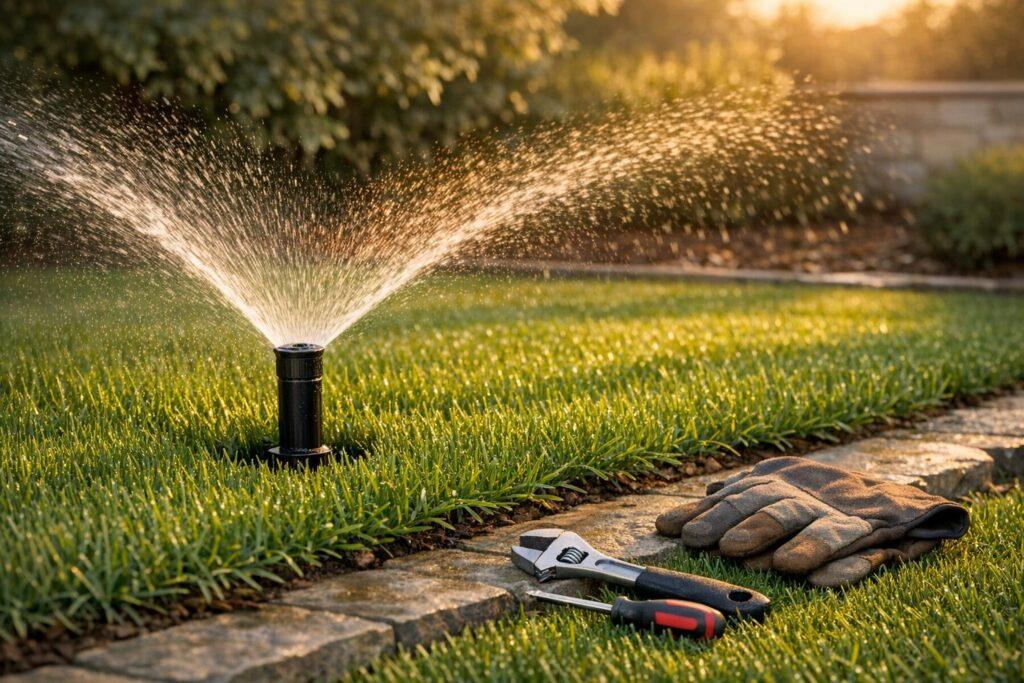
Your irrigation system works hard to keep your landscape healthy, but without regular upkeep, it can waste water, increase costs, and cause damage. Here’s how to maintain efficiency and avoid expensive repairs:
- Inspect the system regularly: Look for leaks, damaged sprinkler heads, and pressure issues. Fix problems early to save up to 25,000 gallons of water and $280 every six months.
- Clean components: Filters, nozzles, and pipes can clog with debris or sediment. Clean them twice a year to ensure smooth operation.
- Adjust controllers and sensors: Update schedules seasonally, test rain and freeze sensors, and replace batteries annually to optimize watering.
- Test water distribution: Use a catch-can test to check for even coverage and adjust sprinkler heads as needed to avoid overwatering or dry spots.
- Record maintenance: Keep logs of inspections, repairs, and system settings to track performance and spot trends.
If managing this feels overwhelming, professional services like Dependable Lawn Care offer plans for system audits, repairs, and seasonal adjustments to keep everything running smoothly.
Tip: Preventive care extends the life of your system and reduces water waste, saving money while keeping your landscape lush.
5-Step Irrigation System Maintenance Checklist with Water Savings
System Inspection Before Maintenance
Before diving into maintenance tasks, take the time to inspect the entire irrigation system carefully. Manually test each zone for about 3 minutes to spot any issues as they occur. Since many systems operate overnight, problems like broken sprinkler heads or leaks can go unnoticed for weeks. During the inspection, focus on leaks, sprinkler head performance, and maintaining consistent pressure throughout the system.
Checking for Leaks and Damage
Start by looking for telltale signs of leaks, such as pooling water, soggy patches of grass, boggy areas, or soil erosion. Puddles on driveways and sidewalks can also point to a problem. If your water bill has unexpectedly spiked, it could be due to an underground leak that hasn’t shown visible signs yet.
"Water that constantly seeps from a sprinkler head indicates a leak in a control box valve." – Colorado State University Extension
Inspect valve boxes to ensure all connections are secure and that valves close fully. If water continues to seep from a sprinkler head while the system is off, it’s likely a valve issue. Use flags to mark any damaged components so they can be repaired quickly once the system is shut down.
Inspecting Sprinkler Heads and Nozzles
Take a close look at each sprinkler head. Check for damage, missing parts, or heads that fail to fully emerge. Heads that are tilted can lead to uneven watering, causing dry spots, so ensure they’re positioned correctly. Dense grass or weeds can also obstruct sprinkler heads, especially after mowing, so clear away any growth that might block them from popping up or retracting.
Pay attention to how the water is being distributed. Irregular patterns like wild streams, misting, or heads that aren’t emitting water at all may indicate clogging caused by dirt, sediment, or mineral buildup. If a sprinkler head won’t retract after its cycle, try tapping it gently during operation to free any stuck debris.
Checking System Pressure
Use a pressure gauge attached to a hose bib to measure the system’s water pressure. Perform this check during the system’s usual runtime to account for any fluctuations. Residential irrigation systems typically function best within a range of 40 to 60 psi, but specific components have their own ideal pressures: rotors around 45 psi, spray heads around 30 psi, and drip lines near 20 psi.
Pressure that’s too high can result in misting, where water evaporates or gets blown away before it reaches the ground. On the other hand, low pressure can prevent sprinkler heads from popping up fully, leading to uneven watering and dry spots shaped like donuts. If the pressure seems off, double-check that the isolation valve and backflow preventer valves are completely open before assuming a more complex issue.
| Pressure Issue | Visual Sign | Impact |
|---|---|---|
| High Pressure | Misting or fogging around heads | Water evaporates or blows away before soaking |
| Low Pressure | Heads not fully popping up | Uneven watering with dry, donut-shaped spots |
| Correct Pressure | Uniform spray reaching adjacent heads | Efficient and even water distribution |
Cleaning and Filter Maintenance
Keeping your sprinkler system’s filters, pipes, and nozzles clean is key to preventing blockages that waste water and disrupt coverage. Regular maintenance – ideally twice a year in late spring and late fall – helps your system run smoothly, avoiding clogs before winter storage or summer use. Start with filter care, then move on to flushing pipes and cleaning nozzles for a thorough tune-up.
Cleaning or Replacing Filters
To clean the filter, begin by lifting the sprinkler riser. Unscrew the cap or nozzle, and carefully remove the filter screen using needle-nose pliers. Rinse the filter under running water, and scrub it gently with a soft-bristled brush to remove dirt and debris. For hard water mineral buildup, soak the filter in vinegar or a calcium, lime, and rust remover for about 30 minutes. Avoid using abrasive cleaners that could damage the filter. Before reassembling, inspect the O-rings – if they appear dry, apply a small amount of Vaseline to ensure a proper seal. When reinserting the filter, make sure it’s oriented correctly, with alignment marks matching the nozzle opening. Once the filters are cleaned or replaced, flush the pipes to clear out any remaining sediment.
Flushing Pipes and Lines
Flushing your system clears out debris and sediment that can build up in pipes and valves. Start by removing the sprinkler head, then flush the system through the open valve for about 5 minutes. This process removes grit and buildup that could clog nozzles or reduce water flow. Perform this step before reattaching cleaned sprinkler heads to prevent freshly cleaned components from getting clogged again. If you notice low water pressure during testing, it’s often a sign of debris in the lines that needs to be flushed out.
Cleaning Nozzles and Emitters
To clean nozzles, remove them and soak them in a rust, calcium, or lime remover for 30 minutes to dissolve mineral deposits. After soaking, scrub away any remaining debris with a soft-bristled brush. Before removing the nozzle, mark its position so you can easily reinstall it in the correct alignment. For drip emitters, try blocking the water flow at the outlet momentarily and then releasing it to force out debris. If that doesn’t work, blow air through the nozzle from the outlet side to dislodge any clogs. After cleaning, apply a lubricant like WD-40 to moving parts to prevent future mineral buildup and ensure smooth operation.
| Component | Cleaning Method | Tools Needed |
|---|---|---|
| Filter Screens | Rinse and scrub with a soft brush | Toothbrush, pliers, water |
| Nozzles | Soak in rust remover for 30 mins; scrub | Bucket, rust remover, brush |
| Drip Emitters | Block outlet to build pressure, then release | Manual pressure |
| Pipes/Lines | Flush with water for 5 mins (heads removed) | Wrench |
Controller, Valve, and Sensor Checks
Once the cleaning is done, it’s time to focus on the components that control your irrigation system’s water flow and timing. These include controllers, valves, solenoids, and sensors. Together, they ensure your system operates efficiently, adjusting to weather conditions and automating your irrigation schedule. Regular inspections help maintain proper communication between components and prevent water waste, which can account for 50% of a property’s total water use and cost. Keeping these systems in check ensures your irrigation setup is as dependable as its physical parts.
Testing Controllers and Timers
Start by confirming that the controller powers on and is set to the correct settings. Replace the backup battery once a year to avoid unexpected failures. Most modern controllers have an automated test mode that runs each zone for about one minute. Use this feature to ensure the controller is properly communicating with the valves. Clean out dust and pests from the controller box and inspect the wiring for corrosion or loose connections.
Adjust your irrigation zone schedules twice a year – once in spring and again in fall – to match seasonal water needs. During the peak summer months (July through September), set your system to run at 100% capacity. Scale back to 80% in October, May, and June, 50% in November, March, and April, and as low as 20% during the winter months of December through February to avoid overwatering.
Inspecting Valves and Solenoids
Open valve boxes and clear out any debris. Check the wiring connections on solenoids for signs of corrosion or looseness, and secure them with waterproof connectors. Examine valves for any physical damage or leaks. If a sprinkler head drips water even when the system is off, it might indicate a leaky control valve or a worn diaphragm. To confirm, check your water meter’s leak indicator (often a red triangle or star). If it moves while the system is off, a control valve may be partially open, or "weeping", and not shutting off completely.
Before turning on the main water supply, make sure all manual drain valves are securely closed. Open valves slowly to avoid pressure surges, which can damage the system.
Checking Weather Sensors and Batteries
Rain and freeze sensors are crucial for preventing unnecessary watering during rainstorms or freezing conditions, which can lead to water waste and ice damage. Ensure sensors are installed in open areas, free from obstructions like overhanging branches. Trim any vegetation that could block rainfall from reaching the sensor. Double-check that the controller is set to "Active" or "Sensor On" instead of "Bypass." Inspect the wiring for corrosion or improper "jumper" loops that might disable the sensor’s functionality.
For soil moisture sensors, confirm they are buried at the recommended depth and haven’t been exposed due to erosion. Clean off any dirt, debris, or spider webs to ensure they can accurately detect environmental conditions. Rain sensors should be set to activate at 0.25 inches of rainfall for optimal performance.
sbb-itb-5aa6250
Coverage, Adjustment, and Performance Testing
Once your system components are verified, the next step is ensuring water is distributed evenly across your entire landscape. Uneven water distribution can lead to higher costs and inefficiencies, leaving some areas too dry while others become oversaturated. A system with a Distribution Uniformity (DU) of 70% is considered excellent, while anything below 50% should be addressed immediately.
Adjusting Sprinkler Heads
Properly aligned sprinkler heads are key to an efficient irrigation system. Make sure they’re perpendicular to the ground and pop up high enough to clear the grass canopy. Over time, heads may need to be raised as thatch builds up. Misaligned or tilted heads can throw water unevenly, creating dry patches. Also, trim any grass or weeds blocking the spray pattern to maintain proper coverage.
For gear-driven rotors, use a hex wrench to adjust the arc – turn clockwise to increase it or counter-clockwise to decrease it. You can reduce the spray distance by turning the center screw clockwise. For pop-up spray heads, use a flat-head screwdriver to adjust the radius while the system is running. Rotate the stem manually to ensure the spray pattern aligns with your landscape edges, avoiding sidewalks and driveways.
Monitoring Soil Moisture and Pressure
Keep an eye on your lawn for signs of under- or over-watering. Brown, withered grass usually signals under-watering, while soggy or mossy areas indicate over-watering. Make sure your system pressure stays within the ideal range of 40 to 65 PSI. Misting often points to high pressure, while incomplete head pop-up might suggest low pressure or a leak in the system.
To check water distribution, perform a catch-can test. Place 5–10 straight-sided containers in one zone. For fixed spray heads, position the containers halfway between the heads. For rotors, space the containers every one-third to one-fourth of the distance between heads. Run the system for 5 minutes (fixed sprays) or 15 minutes (rotors) when wind speeds are 5 mph or less. Use a ruler to measure the water depth in each container to the nearest 1/8 inch.
| Average Water Depth After 15 Minutes | Total Minutes Needed to Water 1 Inch |
|---|---|
| 1/8 inch | 120 minutes |
| 1/4 inch | 60 minutes |
| 1/2 inch | 30 minutes |
| 3/4 inch | 20 minutes |
| 1 inch | 15 minutes |
Testing Zones for Problems
Once you’ve measured water distribution, it’s time to inspect each zone for issues like leaks or uneven coverage. Run each zone individually and look for potential problems. Listen for water hammer, a banging noise when valves open, which could indicate dangerous pressure surges. Check for muddy or barren spots near valves, as these could point to leaks. Ensure each sprinkler reaches the next one (a concept called head-to-head coverage) to avoid dry areas.
If you notice runoff before the soil absorbs the water – especially in areas with clay-heavy soil – try a cycle-and-soak method. Break watering times into shorter intervals with pauses in between. This allows water to soak deeper into the soil rather than pooling on the surface, reducing erosion and runoff. Addressing issues like broken heads or leaks early can save you up to 25,000 gallons of water and $280 over a six-month period.
Taking the time to make accurate adjustments and run performance tests ensures your irrigation system operates efficiently and saves resources in the long run.
Record-Keeping and Dependable Lawn Care Services
Documenting Maintenance Activities
Keeping track of your irrigation system’s performance and maintenance is a smart way to extend its life and catch potential issues early. Start by logging key metrics like outlet pressure, flow rate, operating hours, and energy use every month. This creates a baseline, making it easier to notice when pumps or motors start losing efficiency. For instance, sprinkler nozzles often need replacing after about 10,000 to 12,000 hours of use – having records helps you know when that time is approaching.
Document every maintenance task you perform, whether it’s cleaning filters, flushing pipes, replacing nozzles, or fixing leaks. Include results from catch-can tests, such as average water depth and the calculated application rate (in inches per hour) for each zone. When you adjust your controller settings for seasonal changes, make a note of the updated run times and watering schedules. Over time, this historical data becomes a valuable resource for spotting trends – like a drop in flow rate or pressure – that might indicate worn-out components before they cause bigger problems.
A simple spreadsheet or logbook works well for organizing your records. Break it down into categories like system data, maintenance activities, adjustments, calibration results, and repairs. Be sure to date each entry and include specific details, such as which zone had a leak or which sensor battery was replaced. If the process feels too complicated, you can always rely on professionals to ensure nothing gets overlooked.
Dependable Lawn Care’s Irrigation Services
Detailed records not only make DIY maintenance easier but also help professionals diagnose issues more efficiently. If keeping up with logs and regular inspections feels like too much, professional services can save you time and hassle. Dependable Lawn Care offers a full range of sprinkler system services for properties in Oakville and Mississauga, including system audits, leak detection, spring startups, and fall winterization. Their technicians use high-quality tools – like professional-grade air compressors for winterization – to protect your system from frozen pipes and expensive damage.
They offer three service plans to suit different needs. The Bronze Plan provides essential maintenance and support. The Silver Plan includes routine system checks for added peace of mind. For the most comprehensive care, the Gold Plan offers full irrigation management with priority service, ensuring your system operates at its best all year. Additional services include backflow device testing and on-site repairs with replacement parts readily available, so small problems are fixed quickly before they turn into costly repairs.
Conclusion
Taking care of your irrigation system is more than just routine upkeep – it’s about protecting your investment and keeping costs in check. Even one malfunctioning part can lead to wasted water and higher bills. Regular tasks like inspections, cleaning filters, adjusting controllers, and winterizing your system can help avoid these problems while ensuring your system lasts longer.
Maintenance isn’t just about saving money; it’s also key to keeping your system efficient. Irrigation can account for up to 50% of a property’s water use, so spotting small issues early – like clogged nozzles, misaligned sprinkler heads, or worn-out sensors – can prevent expensive repairs and keep your landscape thriving.
"The goal of irrigation system maintenance is to create the most efficient irrigation system possible so that water is not wasted on the landscape." – Utah State University Extension
If the idea of managing inspections, seasonal tweaks, and record-keeping seems like too much, professional services can take the load off. Dependable Lawn Care offers flexible plans – Bronze, Silver, and Gold – that include everything from spring startups to fall winterization and on-site repairs. By partnering with Dependable Lawn Care, you ensure year-round reliability and long-term savings for your irrigation system.
FAQs
How often should I check my irrigation system for leaks and damage?
To keep your irrigation system running smoothly and avoid unnecessary expenses, make it a habit to inspect it at least three times a year – once during spring start-up, again mid-season, and finally before winterizing. These regular checkups not only help your system run efficiently but also conserve water and prevent costly repairs.
During each inspection, watch for common issues like broken sprinkler heads, clogged nozzles, or areas where water is pooling. Tackling these problems early ensures your lawn stays lush and your irrigation system remains in great condition.
Why is it important to adjust your irrigation system settings for each season?
Seasonal adjustments to your irrigation system are key to giving your plants the water they need year-round. During cooler months, this helps avoid overwatering, while in hotter weather, it ensures your plants stay hydrated. The result? Healthier growth and smarter water use.
Fine-tuning your irrigation schedule with the seasons not only keeps your landscape thriving but also cuts down on water waste and can even trim your utility bills. It’s an easy step that benefits both your garden and the environment.
What are the benefits of hiring professionals for irrigation system maintenance?
Hiring professionals to take care of your irrigation system keeps it running smoothly and dependably all year long. Skilled technicians can spot and fix common problems like leaks, clogged nozzles, or sprinkler heads that are out of alignment. These fixes help prevent water waste and those frustrating dry spots on your lawn. They also manage tasks like controller programming, seasonal adjustments, and inspecting rain sensors, ensuring your lawn gets just the right amount of water, regardless of the weather.
For larger systems, experts tackle more complex jobs such as pump maintenance and system upgrades, which can extend your equipment’s lifespan and help you avoid costly repairs down the road. Letting professionals handle these responsibilities not only saves water and cuts down on utility bills but also gives you a lush, thriving lawn – without the headache of doing it yourself. Dependable Lawn Care offers a full range of irrigation services, from routine check-ups to seasonal prep, so your lawn stays in top shape year-round.