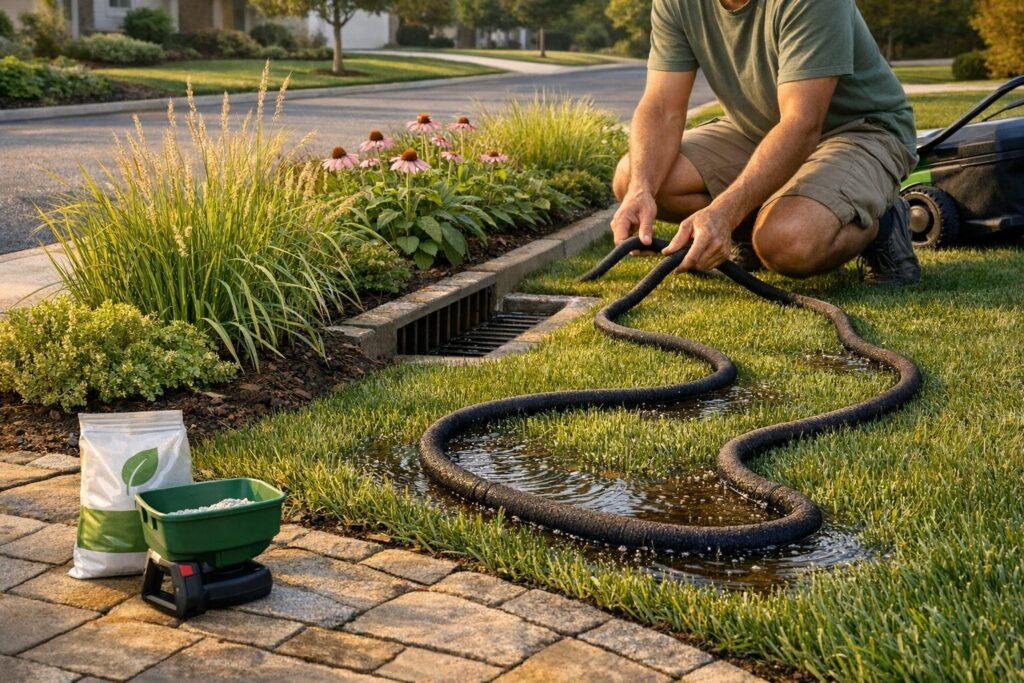
Fertilizer runoff can harm waterways, fuel algae blooms, and disrupt aquatic life. But with a few smart practices, you can protect water quality while improving your lawn. Here’s how:
- Fertilize during dry weather: Apply only when dry weather is forecasted, and avoid heavy rain to prevent washing nutrients away.
- Use slow-release fertilizers: These provide nutrients gradually, reducing runoff by up to 50%.
- Leave grass clippings on the lawn: Clippings naturally recycle nutrients, cutting fertilizer needs by up to 75%.
- Plant buffer strips near water: Vegetated areas trap runoff before it reaches streams or lakes.
- Water less often but deeply: Deep watering helps nutrients reach roots instead of washing away.

5 Ways to Reduce Fertilizer Runoff in Lawns with Key Statistics
1. Apply Fertilizer During Dry Weather
Timing is everything when it comes to fertilizing your lawn. Only apply fertilizer when dry weather is expected. Check the forecast 24 to 48 hours ahead to ensure there’s a dry window. This allows the soil to soak up nutrients effectively before any rain arrives.
A light rain (around 1/4 inch) can actually help by moving the fertilizer into the soil. However, heavy rain (more than 1 inch) can wash it away or push it too deep, beyond the reach of plant roots. As James Collins from Pure Home Gardens explains:
Light rain can help move fertilizer into the soil, while heavy rain can wash it away and waste your effort.
Also, avoid fertilizing on waterlogged ground. Instead, pick a dry day, apply the fertilizer as part of your lawn care services, and then water lightly with about 1/4 inch. Use tools like catch-cans to measure how much water you’re applying and ensure it’s just enough to settle the granules into the soil.
Finally, if any fertilizer spills onto hard surfaces like driveways or sidewalks, sweep it back onto the lawn immediately. This prevents it from being washed into storm drains during the next rain, helping both your lawn and the environment.
sbb-itb-5aa6250
2. Choose Slow-Release Fertilizers
When it comes to managing nutrients effectively with residential lawn care in Oakville, slow-release fertilizers are a smart choice for reducing runoff. Unlike quick-release options that dump all their nutrients at once, slow-release fertilizers work over weeks or even months, providing a steady supply of nutrients. This gradual release means there’s less excess fertilizer to be washed away by rain.
Using slow-release fertilizers can cut nutrient runoff by 35% to 50% compared to traditional fertilizers. Plus, you’ll need 20% to 30% less fertilizer to achieve the same results. That’s a win for both your budget and the environment.
When shopping, look for fertilizers with ingredients like sulfur-coated urea, polymer-coated urea, urea-formaldehyde, or IBDU. These are designed to release nutrients over a period of 4–12 weeks, and some even last up to 16 weeks. For example, in Florida, a fertilizer can only be labeled as "controlled-release" if less than 15% of its nutrients are released in the first 24 hours and less than 75% within 28 days.
While slow-release fertilizers like ESN may cost more upfront – $650/ton compared to $481/ton for quick-release options – you’ll save money in the long run thanks to fewer applications and less waste. This balance makes them a cost-effective and environmentally friendly choice.
Steer clear of quick-release fertilizers on sandy soils. Sandy ground drains quickly, allowing nutrients to leach into groundwater before plants can absorb them. Slow-release fertilizers are especially beneficial in these conditions, ensuring nutrients stay accessible to plant roots while protecting water quality.
3. Leave Grass Clippings on Your Lawn
Grass clippings act like slow-release fertilizers, providing a simple, natural way to keep nutrients in your soil. When you leave clippings on your lawn, they break down and return essential nutrients like 3–4% nitrogen, 0.5% phosphorus, and 2.5–3.5% potassium back to the soil.
Penn State research revealed that over three years, Kentucky bluegrass clippings returned 46% to 59% of the nitrogen applied as fertilizer to the lawn. This means you could cut your nitrogen fertilizer use by 33% to 75%. Alec Kowalewski, a professor at Oregon State University, explains:
Our research has shown that we can cut the fertilizer application rate almost in half when we return clippings with a mulching-type rotary mower.
By leaving clippings on the lawn, you recycle nutrients directly into the soil, reducing the need for extra fertilizer and minimizing the risk of runoff.
For best results, mow weekly with a mulching mower, following the one-third rule (never cut more than one-third of the grass blade at a time). Keep mower blades sharp, sharpening them every 20–25 hours of use, to ensure clean cuts and faster decomposition. Mulching mowers finely chop clippings, allowing them to settle into the turf and decompose within weeks.
Contrary to common belief, grass clippings don’t contribute to thatch buildup. Thatch forms from old stems and roots, not leaf clippings. As Kowalewski points out:
All research conducted with turf has shown that grass clippings do not increase thatch.
This practice can also improve water infiltration by 12% and increase net carbon sequestration by 11% to 59%, making it an excellent addition to your lawn care routine while helping to reduce runoff.
4. Plant Buffer Strips Near Water
Buffer strips are vegetated areas placed between your lawn and nearby water sources to catch fertilizer runoff before it reaches the water. These strips act like nature’s filter, keeping harmful nutrients out of ponds, streams, and drainage systems. Anthony Reardon, Horticulture Small Farms Agent, describes their importance:
By implementing erosion control practices like contour gardening, terracing, and planting vegetative buffer zones along water routes, gardeners can prevent soil loss and protect water quality.
These buffers not only safeguard water quality but also strengthen your landscape against erosion.
For the best results, the NRCS suggests a grass buffer of at least 20–30 feet. If you have more room, aim for a three-tier system: water-tolerant trees, fast-growing shrubs, and native grasses. This setup captures more sediment. Even if you can’t reach the ideal 100-foot width, any buffer is better than none.
Choose native grasses with sturdy stems, such as Switchgrass, Big Bluestem, or Indiangrass. In cooler regions, consider Western Wheatgrass or Virginia Wild Rye. Avoid smooth brome grass – it flattens under heavy water flow, allowing runoff to bypass the filter.
On steep slopes, wider buffers are essential to give water more time to soak into the ground. If space is tight, even a 5-foot strip of native grasses can make a difference, though wider strips work better. Be sure to inspect your buffer strips every year – or after major storms – for signs of erosion or sediment buildup that might require reseeding.
5. Water Less Often but More Deeply
Adjusting how you water your lawn is another way to cut down on runoff, alongside changes to fertilizer use and adding vegetative buffers. Frequent, shallow watering keeps the surface wet, which encourages fertilizer to wash away. This practice also leads to shallow root growth, leaving nutrients sitting at the surface where they’re more likely to be carried off.
Instead, aim for deep, infrequent watering. Applying 1/2 to 3/4 inch of water at a time allows moisture to soak through the entire root zone, pulling fertilizer down to where grass roots can absorb it. The University of Florida Extension highlights a potential downside of overwatering:
When the water moves below the root zone, mobile nutrients such as nitrate-N may move below the root zone and out of the plant’s reach.
Water your lawn only when it shows signs of needing moisture. Watch for grass blades folding lengthwise, a blue-gray tint, or footprints that linger instead of springing back. This method encourages roots to grow deeper – sometimes reaching 6 to 8 inches – making the lawn stronger and better at retaining nutrients.
Right after fertilizing, apply 1/4 inch of water to help granules sink into the soil. Be careful not to overdo it, especially with sandy soils, as they can only hold about 0.75 inches of water per foot of depth. Too much water can cause nutrients to leach out of reach. If your soil is compacted and water pools on the surface, consider core aeration to create pathways for water and nutrients to penetrate the root zone.
For more consistent deep watering, consider adding a rain sensor or soil moisture sensor to your sprinkler system. These tools can prevent unnecessary watering when the soil already has enough moisture. Without these adjustments, automated systems may use 47% more water than manual watering, which can lead to fertilizer being washed into storm drains unnecessarily.
Conclusion
Using these five strategies – applying fertilizers during dry weather, opting for slow-release options, grasscycling, planting buffer strips near water, and watering deeply – helps keep nutrients where they belong: in your lawn’s root zone, not in nearby waterways. As Alex J. Lindsey, Assistant Professor at UF/IFAS, puts it:
The goal of proper nutrient management should be to apply the minimum necessary nutrients to achieve an acceptable quality and to apply these nutrients in a manner that maximizes their plant uptake.
The consequences of poor nutrient management are serious. In August 2014, a harmful algal bloom in Lake Erie caused Toledo, Ohio, to issue a two-day drinking water ban for 400,000 residents. The National Oceanic and Atmospheric Administration estimated the economic fallout at $65 million. The primary culprit? Nutrient runoff – mainly nitrogen and phosphorus – from fertilizers entering waterways.
A well-maintained lawn acts as a natural filter, trapping nutrients and safeguarding water quality. By following these practices, you’re not just improving your lawn – you’re also helping to protect vital water resources from nutrient pollution. Simple steps like maintaining a 10-foot unfertilized buffer around water bodies and applying fertilizers correctly can make a noticeable difference.
For homeowners looking for extra guidance, professional services like Dependable Lawn Care offer tailored plans to build on these strategies. Their Gold plan, for instance, includes soil testing, carefully timed application schedules, and expert advice aligned with your lawn’s growth cycles. This personalized approach ensures you’re using the right nutrients in the right way, benefiting both your lawn and the environment.
FAQs
How do I know how much fertilizer my lawn actually needs?
The most reliable way to figure out what your lawn needs is by conducting a soil test. This test reveals the specific nutrients your soil lacks, allowing you to tailor your fertilizer application.
If a soil test isn’t an option, stick to fertilizing when your grass is actively growing. For most lawns, this means applying 2–4 pounds of nitrogen per 1,000 square feet annually. It’s best to split this amount into several applications throughout the year.
Timing is everything. Applying fertilizer in the spring or fall not only supports healthy growth but also minimizes the risk of runoff, which can harm nearby water sources.
What’s the easiest way to tell if my fertilizer is slow-release?
The simplest way to spot a slow-release fertilizer is by checking if it offers consistent, extended feeding for 6–12 weeks. These fertilizers are made to release nutrients gradually, promoting steady lawn growth while reducing the need for frequent applications.
How wide should a buffer strip be near a pond or stream?
A buffer strip next to a pond or stream should be a minimum of 25 feet wide. In areas with steep slopes or where erosion is a concern, wider buffer zones are advised to provide better protection for water quality and reduce runoff.